
Coming On Board as an Executive: Your First 30 Days With a System You Didn't Build
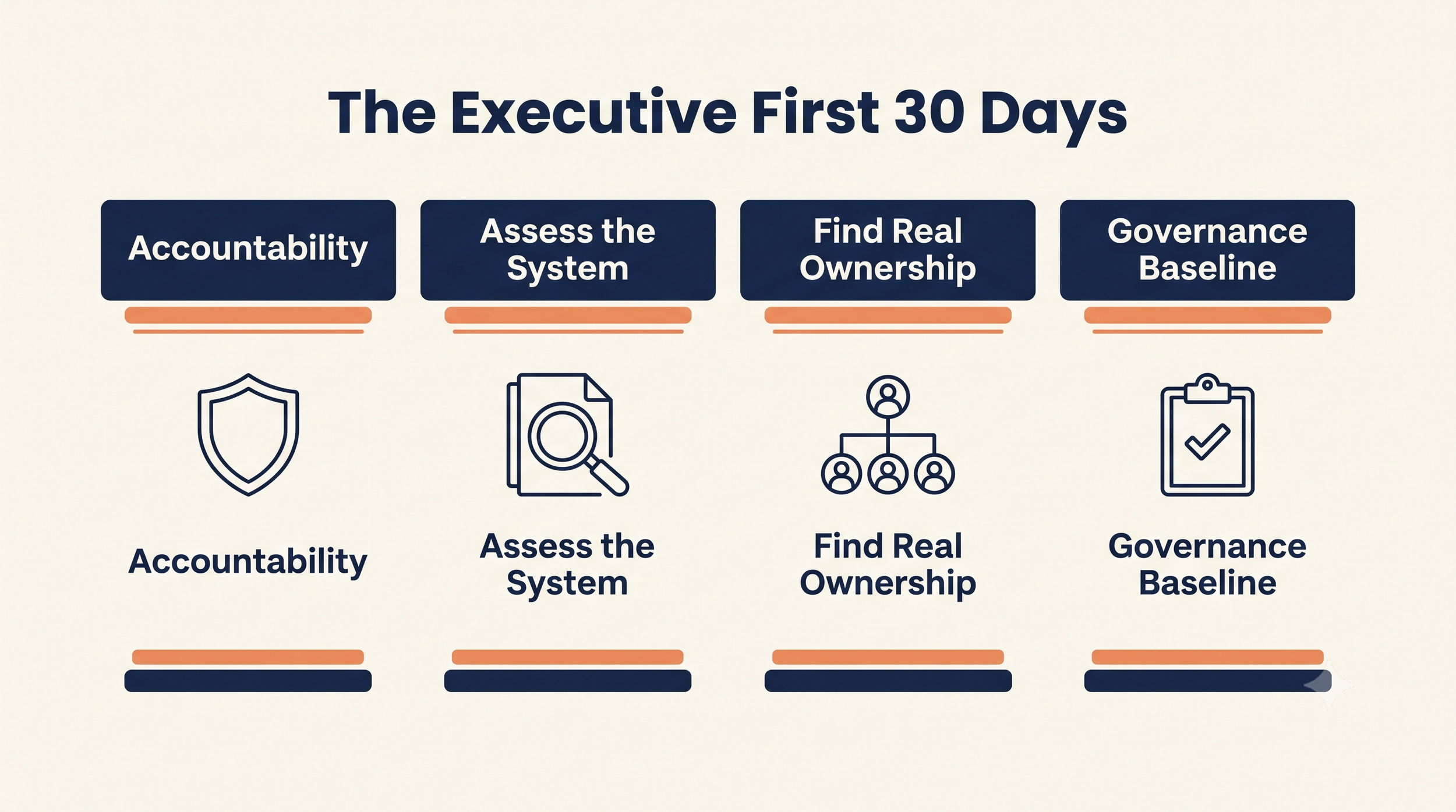
When an executive joins a new business, they inherit more than a role. They inherit a management system, a risk profile, a set of accountabilities, and a history of decisions they were not present for. From day one, the organisation holds them responsible for outcomes produced by a system they did not design and do not yet understand.
This is the central tension of the executive first month. The expectations are immediate. The understanding is not. And the executives who navigate this period well are rarely the ones who move fastest. They are the ones who take deliberate ownership of the inherited system before they attempt to reshape it.
This article sets out a first thirty days framework for executives stepping into an established business, particularly businesses operating in regulated environments where quality, safety, and environmental accountability sit with leadership whether leadership is ready or not.
You Are Accountable Before You Are Informed

The uncomfortable reality of executive onboarding is that accountability transfers instantly while knowledge transfers slowly. If the business holds ISO 45001 certification, the safety obligations attached to your role began the day you started. If there is a critical control failure in week two, the fact that you were new is context, not protection. Under Australian WHS legislation, officer due diligence obligations do not have a grace period.
This is not a reason for alarm. It is a reason for sequencing. The first questions an incoming executive should ask are not strategic questions. They are accountability questions:
• What am I now responsible for, formally and legally?
• What are the highest consequence risks in my area, and what controls are supposed to be managing them?
• When were those controls last verified by someone who would tell me the truth?
• What known issues, audit findings, or corrective actions are currently open?
These questions do two things. They protect you, and they signal to the organisation that the new executive treats governance as an operating concern rather than an administrative one. That signal shapes behavior long after the first month ends.
Assess the System You Have Inherited, Not the One on Paper

Most established businesses will hand a new executive a well presented picture of their management system. Certificates on the wall. A document portal. Registers and dashboards. The critical skill in the first month is to assess whether that system is genuinely governing the business or simply describing it.
The distinction is the difference between being certified and being controlled. A certified system has passed an audit. A controlled system actively shapes decisions, surfaces risk early, and produces consistent outcomes when conditions change. Many organisations hold the first without possessing the second, and an incoming executive needs to know which one they have inherited.
Three tests reveal the answer quickly. First, pick a recent incident or nonconformance and trace how the system responded. Was the response led by the system or reconstructed around it afterwards? Second, attend an operational meeting and observe whether the risks discussed match the risks in the register. Third, ask a frontline supervisor to show you how they use the system in a normal week. If the honest answer is that they do not, you have your diagnosis.
Find Where Accountability Actually Lives
In every business, there is a map of where accountability formally sits and a map of where it actually sits. New executives must find both. The formal map is in position descriptions and delegations. The real map is discovered by watching who acts when something goes wrong, who signs off in practice, and whose absence causes work to stall.
Pay particular attention to single points of dependency. Growing businesses often run on the memory and judgement of a small number of long serving people. Their capability is real, but it is capability held in people rather than in systems, and it does not scale and does not survive departure. Identifying these dependencies in your first month is far cheaper than discovering them during a resignation.
Equally, notice what the previous executive personally held together. Roles shape themselves around individuals over time. Some of what you inherit will be genuine role accountability. Some will be personal workarounds that made sense for your predecessor and make no sense for you. Separate the two early, deliberately, and visibly.
Resist the Restructure Reflex
There is a well worn pattern in executive onboarding. The new leader arrives, sees inefficiency, and announces a restructure or a new system within the first six weeks. Sometimes it is even the right change. It almost never lands, because it arrives before the executive understands why the current arrangement exists.
Structures and workarounds are rarely random. They are usually scar tissue, formed around past incidents, past personalities, and past constraints that may or may not still exist. Change made without understanding the original wound tends to reopen it. The first month should produce a documented understanding of why things are the way they are. Only then can you distinguish between structure that protects the business and structure that merely protects habit.
This is not an argument for slowness. It is an argument for aim. An executive who spends thirty days understanding the system can change it in ninety. An executive who starts changing it on day five often spends the next year managing the fallout.
Close the First Month With a Governance Baseline

The tangible output of an executive first month should be a governance baseline: a concise, honest record of the state of the system you inherited. What is certified. What is genuinely controlled. Where accountability sits. Which risks are actively managed and which are managed by luck. Which dependencies would hurt if they walked out the door.
This baseline serves three purposes. It gives you a defensible record of the position you inherited, which matters in regulated environments. It gives the board or founder an accurate picture, often more accurate than the one they have been operating with. And it turns your first month of observation into the foundation of your first year of change, with every future initiative traceable back to a documented starting point.
Executives who do this create something rare: a leadership transition that strengthens the management system instead of disrupting it. In businesses that are scaling, that continuity is not a soft benefit. It is the infrastructure that lets growth continue while leadership changes around it.
