
How Do You Prepare for an External ISO Audit Without Disrupting Day-to-Day Operations?
External ISO audits often create unnecessary tension inside organisations.
Teams suddenly pause normal work. Managers scramble to locate documents. Processes that have operated quietly in the background for months suddenly become the centre of attention. In many businesses, the preparation period feels more disruptive than the audit itself.
But that disruption is not inevitable.
Well-designed ISO management systems — whether ISO 9001 for quality, ISO 45001 for safety, or ISO 14001 for environmental management — are intended to operate as part of normal business operations. When systems are designed correctly, preparing for an external audit should not require organisations to temporarily “switch modes.”
Instead, the audit should simply confirm what is already happening.
Understanding how to prepare for an external ISO audit without interrupting daily work therefore starts with a more fundamental question:
Is the management system genuinely embedded in the organisation, or does it only appear during audit season?
For growing businesses, the difference between those two scenarios is critical.
Why External ISO Audits Often Disrupt Operations
External audits are designed to assess whether an organisation’s management system meets the requirements of the ISO standard and is being implemented effectively.
In theory, that assessment should be straightforward. The organisation simply demonstrates how its processes operate, how decisions are made, and how risks are controlled.
In practice, however, many organisations experience disruption during the preparation phase because the system itself is not fully integrated into day-to-day operations.
Several patterns appear repeatedly.
Sometimes documentation has been created primarily for certification purposes rather than operational use. Procedures exist, but teams do not refer to them regularly. Records are stored, but not organised in a way that supports real-time visibility.
In other cases, system ownership is unclear. Managers understand that the organisation is certified, but responsibility for maintaining the system sits with a single coordinator rather than being distributed across operational leaders.
When these conditions exist, preparing for an external audit often triggers a period of “system reconstruction.” Teams begin gathering records that should already be accessible. Processes are reviewed rapidly rather than being monitored continuously. Evidence is assembled rather than simply presented.
The result is operational disruption.
But this situation reflects system design problems rather than audit requirements.
The Principle of Audit-Ready Systems
The most effective organisations treat external audits as confirmation exercises rather than preparation projects.
Their management systems are designed around a simple principle:
The organisation should be audit-ready at any time.
This does not mean teams constantly prepare for auditors. It means that the normal operation of the business already generates the evidence required for audit.
When systems are structured this way, external audits become far less disruptive.
Quality objectives are already monitored through operational dashboards. Safety inspections are conducted routinely as part of operational management. Environmental performance metrics are reviewed as part of standard reporting.
Because the system operates continuously, the audit simply observes what already exists.
This approach also reflects the intent of modern ISO standards, which emphasise integrated management and organisational leadership rather than procedural documentation.
Leadership Ownership Reduces Audit Disruption
One of the most important factors influencing audit readiness is leadership ownership.
ISO systems often struggle when they are treated as compliance projects managed by a single specialist or consultant. While these roles can provide coordination and expertise, they cannot substitute for operational ownership.
Quality performance must be owned by operational leaders.
Safety culture must be embedded within frontline supervision.
Environmental responsibilities must be integrated into operational planning and decision-making.
When leadership ownership is clear, the management system becomes part of everyday management activity. Reviews, performance monitoring, and corrective actions occur naturally as part of business operations rather than being activated shortly before an audit.
This significantly reduces preparation pressure.
External auditors are not looking for perfectly prepared documentation packages. They are evaluating whether leadership understands and manages the system.
When leaders can explain how processes operate and demonstrate how decisions are informed by system data, audits proceed smoothly and without major disruption.
Integrated Systems Reduce Administrative Burden
Many organisations operate multiple ISO standards simultaneously.
Quality management under ISO 9001.
Workplace safety under ISO 45001.
Environmental management under ISO 14001.
When these systems are implemented separately, preparation for external audits becomes complex. Each standard generates its own documentation, reporting cycles, and audit evidence requirements.
Over time this fragmentation increases administrative workload and creates confusion around responsibilities.
Integrated management systems provide a more effective approach.
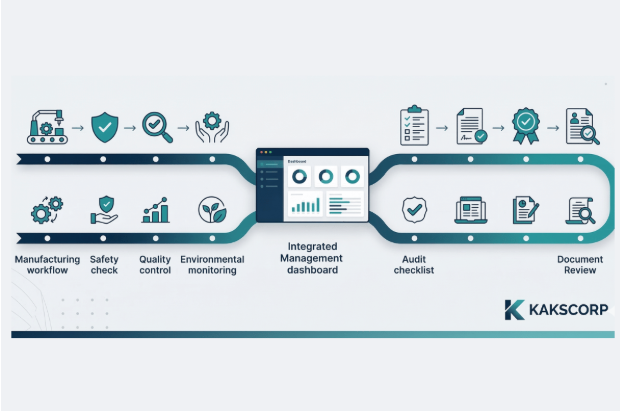
Because modern ISO standards share a common structure, many system elements can be combined. Risk management frameworks, internal audit programs, leadership reviews, and corrective action processes often apply across all three standards.
By integrating these processes, organisations reduce duplication and create clearer operational visibility.
This integration also simplifies audit preparation.
Rather than gathering information from multiple disconnected systems, the organisation can demonstrate how a single management framework supports quality, safety, and environmental performance simultaneously.
Auditors often find integrated systems easier to evaluate, and organisations experience less disruption when audits occur.
Internal Audits as Operational Health Checks
Internal audits play an essential role in maintaining audit readiness.
However, their purpose is often misunderstood.
Internal audits should not exist solely to prepare the organisation for certification audits. When used effectively, they function as operational health checks that help leadership understand whether processes are working as intended.
By identifying issues early, internal audits prevent last-minute corrections during external audit preparation.
More importantly, they reinforce the idea that the management system belongs to the organisation itself rather than to the certification process.
Teams learn to view audits as opportunities for improvement rather than compliance exercises.
When internal audits are conducted regularly and constructively, external audits rarely introduce unexpected findings. Evidence already exists, improvements have already been discussed, and leadership is already aware of system performance.
This continuity removes much of the operational disruption that organisations fear.
Documentation That Supports Operations
Another common source of audit disruption is documentation that does not match operational reality.
In some organisations, procedures are written in a highly formal style that makes them difficult to use during everyday work. Teams rely on informal knowledge rather than documented processes, which means documentation must be revisited before each audit.
This creates the impression that the system exists separately from operations.
Effective ISO documentation works differently.
It reflects how the organisation actually operates. Procedures are concise, accessible, and aligned with operational workflows. Records are stored in systems that managers already use for performance monitoring and decision-making.
When documentation supports operations rather than describing them from a distance, audit preparation becomes much easier.
The evidence auditors need is already present because it is generated during normal business activity.
Digital Systems and Real-Time Visibility
Many organisations are now strengthening audit readiness through digital management systems.
Digital platforms allow organisations to monitor system performance continuously. Incident reports, corrective actions, environmental data, and quality metrics can all be tracked in real time.
This visibility offers several advantages during external audit preparation.
First, evidence becomes easier to access. Rather than searching through multiple folders or email chains, managers can quickly retrieve records directly from the system.
Second, digital platforms support accountability. Tasks and corrective actions are assigned clearly, and progress can be monitored without relying on manual follow-up.
Third, leadership can maintain ongoing visibility of system performance. This reduces the need for intensive preparation periods because managers are already aware of system status.
The result is a management system that operates continuously rather than episodically.
External audits become checkpoints within a broader operational framework.
Preparing Teams Without Stopping Work
Even in well-designed systems, teams still benefit from brief preparation before an external audit.
However, this preparation should focus on awareness rather than reconstruction.
Managers may review how their processes contribute to the management system. Teams may confirm that records are being captured correctly and that responsibilities are understood.
These conversations help staff feel confident during auditor interviews, but they should not require operational disruption.
When systems are embedded and ownership is clear, the preparation period is relatively light.
Employees simply explain how they perform their work.
Auditors observe how the system functions in practice.
The audit becomes a conversation about organisational effectiveness rather than a compliance exercise.
External Audits as Strategic Conversations
For organisations that approach ISO systems strategically, external audits often deliver unexpected value.
Auditors bring experience from across multiple industries. Their observations can help leadership identify emerging risks, operational improvements, or opportunities for system simplification.
When organisations are not overwhelmed by preparation pressure, they can engage more openly in these conversations.
Instead of focusing on documentation gaps, discussions shift toward performance and improvement.
In this environment, the external audit becomes less about certification and more about organisational learning.
When ISO Systems Work as Intended
Preparing for an external ISO audit should not disrupt day-to-day operations.
If disruption occurs, it usually signals that the management system has not yet been fully integrated into the organisation’s operational framework.
The most resilient ISO systems share several characteristics:
Leadership ownership of system performance
Integrated quality, safety, and environmental management
Documentation aligned with operational practice
Continuous internal auditing and monitoring
Clear digital visibility of system activities
When these conditions are present, organisations rarely need to “prepare” for audits in the traditional sense.
Instead, auditors simply observe the management system operating as designed.
And in those situations, certification becomes not a stressful milestone, but a natural outcome of effective organisational management.