
What Is the Difference Between an Internal Audit and a Certification Audit Under ISO Standards?
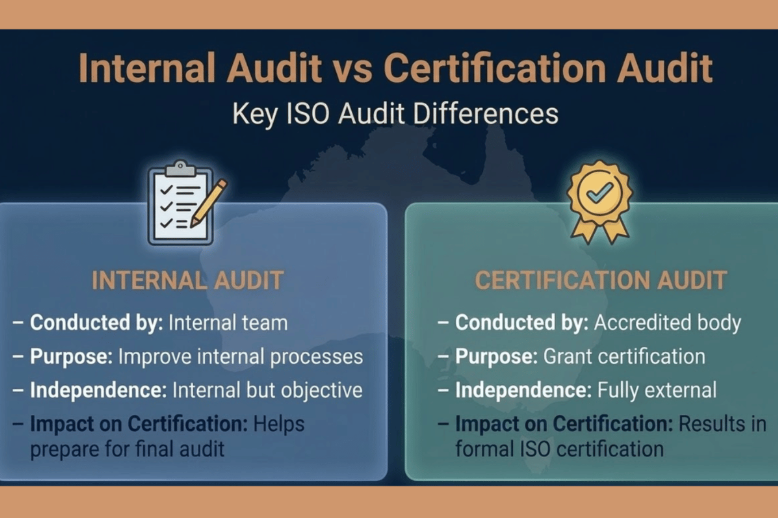
Under ISO management system standards such as ISO 9001 (Quality), ISO 14001 (Environmental) and ISO 45001 (Occupational Health & Safety), organisations are required to conduct internal audits to evaluate their systems.
Certification audits, on the other hand, are conducted by an external certification body to determine whether the organisation meets the requirements for ISO certification.
While both types of audits examine the same management system, their purpose, authority, and outcomes are different.
Purpose of Internal Audits
Internal audits are conducted by the organisation itself to evaluate whether its management system is functioning as intended.
The objective is to determine whether processes:
Conform to ISO requirements
Conform to the organisation’s own procedures
Are implemented effectively
Are maintained and continuously improved
Internal audits act as a management tool. They help organisations detect issues early, correct weaknesses and strengthen system performance before external audits occur.
ISO standards require internal audits to be conducted at planned intervals.
For example:
ISO 9001 clause 9.2 requires organisations to conduct internal audits to determine whether the quality management system conforms to both ISO requirements and the organisation’s own requirements.
ISO 14001 clause 9.2 requires similar verification for environmental management systems.
ISO 45001 clause 9.2 requires internal auditing of occupational health and safety systems.
In practice, internal audits help organisations understand whether their systems actually work in day-to-day operations.
Purpose of Certification Audits
Certification audits are conducted by an independent certification body accredited by a national accreditation authority.
In Australia, certification bodies are typically accredited by JAS-ANZ (Joint Accreditation System of Australia and New Zealand).
The purpose of a certification audit is to determine whether an organisation’s management system meets the requirements of the ISO standard and is eligible for certification.
Unlike internal audits, certification audits determine whether an organisation can obtain or retain an ISO certificate.
Certification audits also verify that the management system is:
Implemented across the organisation
Effectively maintained
Capable of consistently achieving intended results
If conformity is demonstrated, the certification body issues the ISO certificate.
Who Conducts the Audit
One of the most important differences between the two audits is who performs them.
Internal Audit
Internal audits are performed by:
Internal employees trained as auditors
Internal cross-functional auditors
Independent internal audit teams
Sometimes external consultants acting on behalf of the organisation
However, internal auditors must remain independent of the activities they audit.
For example, a safety manager should not audit their own safety program.
Certification Audit
Certification audits are conducted by auditors employed or contracted by an accredited certification body.
These auditors must:
Be independent of the organisation
Be qualified in the relevant ISO standard
Follow formal audit protocols
Report findings to the certification body
The certification body then makes the certification decision.
Audit Authority and Outcomes
The authority and consequences of each audit differ significantly.
Internal Audit Outcomes
Internal audits typically result in:
Nonconformities
Observations
Opportunities for improvement
Recommendations
Internal audit findings are used internally by management to improve processes and address system weaknesses.
They do not affect certification status directly.
However, unresolved issues discovered during internal audits may later become findings during certification audits.
Certification Audit Outcomes
Certification audits may result in:
Major nonconformities
Minor nonconformities
Observations
Positive practices
If major nonconformities are identified, the organisation may be required to correct them before certification can be granted or maintained.
Certification auditors do not provide consultancy advice. Their role is strictly to assess conformity against the ISO standard.
Frequency of Audits
Internal audits and certification audits occur at different intervals.
Internal Audits
Internal audits must be conducted according to an audit programme developed by the organisation.
The frequency depends on:
Process risk
Previous audit results
Operational complexity
Regulatory exposure
Many organisations audit all processes at least once per year, although high-risk areas may be audited more frequently.
Certification Audits
Certification audits follow a formal certification cycle.
This typically includes:
Stage 1 Audit
A readiness review where auditors evaluate whether the organisation is prepared for certification.
Stage 2 Audit
The full certification audit assessing implementation of the management system.
If successful, certification is granted.
Surveillance and Recertification Audits
After certification, organisations undergo periodic external audits to ensure the system continues to operate effectively.
These include:
Surveillance Audits
Conducted annually by the certification body to verify ongoing compliance.
Recertification Audits
Conducted every three years to renew certification.
Internal audits continue throughout this cycle and remain the organisation’s primary self-monitoring mechanism.
Scope and Depth of Audits
Another key difference is the level of organisational coverage.
Internal Audits
Internal audits can be flexible and targeted.
Organisations may audit:
Specific processes
Departments
Operational risks
Regulatory obligations
Management system clauses
Internal audits are often used to investigate areas where performance issues have occurred.
Certification Audits
Certification audits follow a structured sampling approach determined by the certification body.
Auditors will review:
Management commitment
System documentation
Process implementation
Operational controls
Performance monitoring
Corrective action systems
The scope must align with the certification scope defined in the organisation’s management system.
Role of Internal Audits in Certification Success
Although certification audits determine whether an organisation receives ISO certification, internal audits play a critical role in maintaining system effectiveness.
Internal audits allow organisations to:
Identify gaps early
Test system performance
Strengthen process control
Prepare for external audits
In practice, strong internal auditing programmes often lead to smoother certification audits and fewer external findings.
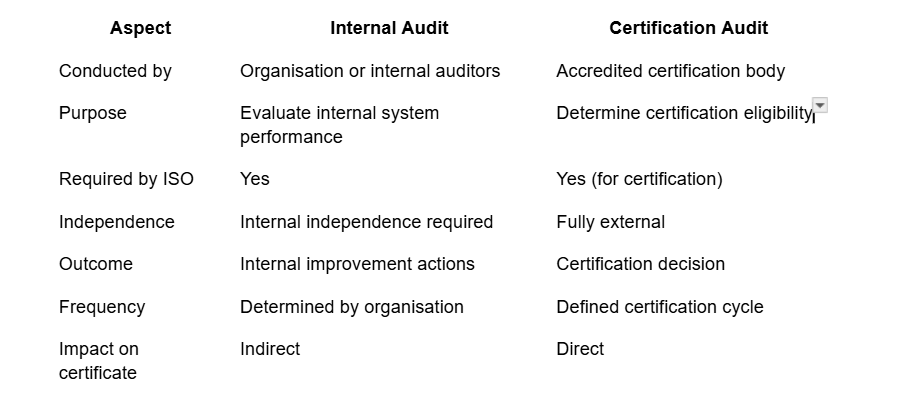
Key Differences at a Glance
Final Perspective
Internal audits and certification audits serve complementary roles within ISO management systems.
Internal audits help organisations understand how well their management systems operate in practice and identify opportunities for improvement.
Certification audits provide independent verification that the management system meets the requirements of the relevant ISO standard.
Together, they create a structured framework for maintaining system integrity, supporting regulatory compliance, and ensuring that organisational processes continue to perform as intended.