
ISO 9001 Without Spreadsheets: Why Traditional Document-Heavy Systems Fail at Scale
For decades, ISO 9001 implementation has followed a familiar and largely unquestioned pattern. Risks are tracked in spreadsheets. Procedures are stored in shared folders. Registers are maintained manually to satisfy audit requirements. Updates are layered onto already stretched operational teams with the expectation that discipline alone will hold the system together.
On paper, this approach appears compliant. Auditors can be shown documents. Registers exist. Evidence can be assembled. Yet beneath the surface, spreadsheet-driven ISO Management Systems quietly introduce fragility into organisations that are attempting to scale.
This fragility does not appear immediately. It emerges as organisations grow, diversify, and take on operational complexity — particularly in highly regulated environments like construction, manufacturing, engineering, fit-out, fire protection, and distribution environments where risk profiles shift constantly. What once felt “manageable” becomes a structural weakness
This is not a failure of ISO 9001 as a standard.
It is a failure of how the standard has traditionally been implemented.
The Hidden Cost of Spreadsheet-Based ISO Systems
Spreadsheets were never designed to function as management systems. They are static tools, reliant on manual updates, personal discipline, and consistent interpretation across teams. In small, stable environments, this limitation is easy to overlook. As ISO Management Systems mature — and as organisations grow — the weaknesses become increasingly difficult to contain.
At first, spreadsheets feel efficient. They are familiar. They are flexible. They give the impression of control. But over time, that control becomes illusory. Each update depends on someone remembering to make it. Each risk assessment depends on individual judgment rather than shared logic. Each register reflects a moment in time, not the current state of operations.
As a result, predictable failure points begin to surface.
Common issues include:
Conflicting risk assessments across multiple documents, created by different teams using slightly different assumptions
Unclear ownership of controls, actions, and reviews, leading to delays and missed follow-through
Manual audit preparation replacing continuous readiness, turning audits into disruptive events
Fragmented data spread across drives, folders, email threads, and personal files, weakening traceability
These issues rarely appear in isolation. They compound. A risk matrix updated in one spreadsheet is not reflected elsewhere. A corrective action logged in a register is not tracked to closure. A procedure is revised, but the previous version remains in circulation. Over time, confidence in the system erodes — not because people are careless, but because the structure cannot support complexity.
In many organisations, these weaknesses remain hidden until formal audits begin. During Stage 1 audits, they often surface as gaps in planning, documentation control, internal auditing, or lifecycle consideration. Organisations respond quickly. Registers are updated. Procedures are rewritten. Files are consolidated. Evidence is assembled.
By Stage 2, certification may be achieved. On the surface, the system appears compliant.
However, this success frequently relies on extraordinary manual effort rather than system strength. Staff work around the system to make it pass. Knowledgeable individuals intervene to bridge gaps. Temporary fixes mask structural issues. Once the audit pressure lifts, those fixes fade.
Normal operations resume — and the same weaknesses re-emerge.
What looks compliant under audit conditions often collapses under everyday workload. Spreadsheets drift out of alignment. Updates fall behind. Ownership becomes unclear again. The ISO system survives audits, but it does not actively support the organisation.
This is the hidden cost of spreadsheet-based ISO systems. Not immediate failure, but slow degradation. Not obvious non-conformance, but increasing fragility. Over time, the system becomes something the organisation manages rather than something that manages risk, quality, and performance.
And at scale, that cost becomes impossible to ignore.
Why Spreadsheet-Based ISO Systems Break at Scale

Scaling exposes what spreadsheets are designed to hide.
As organisations expand, complexity does not increase neatly. It compounds. More people interact with the system. More sites and activities generate risk. More data requires monitoring, review, and interpretation. More decisions depend on timely, accurate information rather than retrospective reporting.
In small environments, spreadsheets can keep pace through informal coordination. People know who owns what. Updates are manageable. Gaps are noticed quickly. At scale, those conditions disappear.
Spreadsheets begin to fracture under the weight of growth.
Version control becomes unclear as multiple copies circulate across teams. Updates occur inconsistently, depending on individual workload and priorities. Registers slowly diverge from operational reality. What is written no longer reflects what is happening. Over time, trust in the data erodes — not because it is wrong in every instance, but because no one is confident it is complete.
As this confidence declines, behaviour shifts.
Teams begin maintaining documents for auditors rather than using systems to manage performance. Risk assessments are updated to satisfy review cycles, not to inform decisions. Corrective actions are logged, but tracking becomes informal and dependent on reminders rather than structure. Management reviews reference data that is technically accurate but operationally outdated.
In high-risk industries, this disconnect becomes more than inefficient — it becomes dangerous.
Risk controls exist on paper but are not embedded in daily work. Safety measures are documented but not consistently reinforced. Environmental obligations are tracked in registers but not actively monitored as conditions change. The ISO system appears complete, yet it no longer influences behaviour where it matters most.
As scale increases, the effort required to maintain spreadsheets grows exponentially. More coordination. More follow-up. More reconciliation. Each additional layer adds friction rather than clarity.
At a certain point, the system flips.
Instead of supporting the organisation, the ISO framework becomes something the organisation must support. Time is spent updating documents rather than improving performance. Energy is diverted into maintenance rather than management. Compliance survives, but capability weakens.
This is where spreadsheet-based ISO systems ultimately fail. Not because spreadsheets are “wrong,” but because they cannot absorb complexity. They were never designed to function as the backbone of an organisation operating across multiple sites, risks, and responsibilities.
At scale, systems must carry the load. When they do not, people are forced to compensate — and that is not a sustainable model for growth.
ISO 9001 Was Never Meant to Be Document-Centric
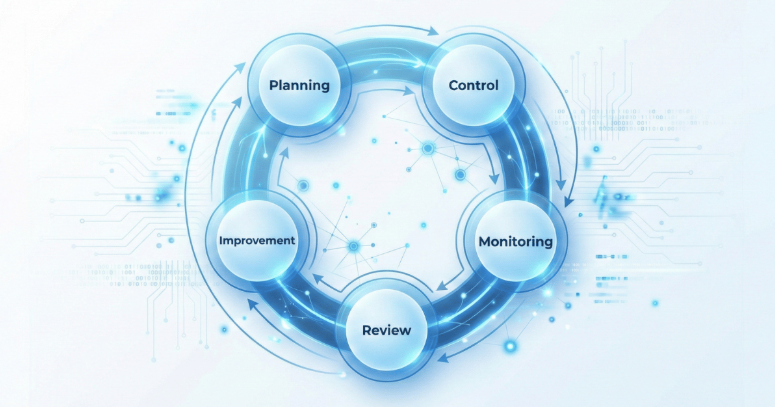
ISO 9001 is fundamentally about how an organisation operates, not how well it stores information. The standard does not ask organisations to prove that documents exist; it asks them to demonstrate that processes function as intended. Evidence is required — but evidence of behaviour, control, and improvement, not evidence of administrative effort.
At its core, ISO 9001 requires organisations to show effective:
Planning — how objectives are set, risks are considered, and resources are allocated
Control — how activities are managed, responsibilities assigned, and outputs governed
Monitoring — how performance is measured and deviations are detected
Review — how leadership evaluates effectiveness and relevance
Improvement — how learning is translated into corrective and preventive action
All of these are dynamic activities. They change as operations change. They respond to new risks, new markets, new teams, and new pressures. They are continuous by design.
Spreadsheet-based systems invert this intent.
Instead of supporting movement, they freeze it. Instead of guiding behaviour, they record it after the fact. Teams become focused on updating the register rather than managing quality in real time. Risk assessments become snapshots rather than living tools. Reviews rely on compiled information rather than current insight. Compliance slowly shifts from an operational outcome to an administrative task.
This distortion is subtle at first. Documents are still accurate. Audits still pass. But over time, the system drifts away from the organisation it is meant to represent.
The problem becomes more pronounced when ISO 9001 is integrated with ISO 45001 and ISO 14001. Health, safety, and environmental risks do not exist in isolation or on a schedule. They evolve with work conditions, sites, weather, materials, and human behaviour. Managing them through static files introduces delay — and delay erodes control.
Effective management of these risks requires:
Live visibility into changing conditions
Consistent terminology across quality, safety, and environmental domains
Structured follow-through that links identification to action
Clear accountability that travels with responsibility
Static documentation cannot provide this. It can describe controls, but it cannot enforce them. It can record decisions, but it cannot guide them. It can show intent, but it cannot sustain behaviour.
ISO 9001 was never intended to be a filing system. It was intended to be a management framework. When organisations treat documentation as the system rather than a by-product of it, they lose the very capability the standard was designed to create.
The moment ISO stops influencing how work is planned, controlled, reviewed, and improved, it stops functioning — regardless of how complete the document set appears.
The Illusion of Control Created by Documents
One of the most damaging aspects of document-heavy ISO systems is the illusion of control they create. Registers exist, so leaders assume risks are being managed. Procedures are written, so teams assume processes are being followed.
In reality, these documents often reflect how the organisation intended to operate at one point in time, not how it currently operates.
When audits expose this gap, organisations respond by adding more documentation. More spreadsheets. More templates. More procedures. Each layer increases complexity while reducing usability.
The system becomes harder to maintain, harder to explain, and harder to trust.
From Records to Systems: A Different Way to Implement ISO
Modern ISO implementation shifts the focus away from documents and toward operational architecture.
Instead of asking, “Where is the spreadsheet?” the more important question becomes, “How does this process function day to day?”
A digital-first ISO Management System replaces static records with living system components that operate together:
Structured workflows for risk identification, incidents, audits, and corrective actions
Live dashboards that show system health and performance at a glance
Controlled documentation with clear revision history and ownership
Embedded digital forms that feed registers automatically
Continuous audit readiness rather than audit-driven panic
In this model, evidence is generated through use. Data flows naturally from operations into oversight. Management reviews are informed by real-time information rather than last-minute compilation.
Compliance becomes a by-product of good system design.
Why Digital-First ISO Systems Succeed Where Spreadsheets Fail
Digital-first ISO systems are not simply electronic versions of existing documents. They are designed around how work actually happens.
Processes guide behaviour rather than describe it. Training is embedded where decisions occur. Accountability is visible. Actions are tracked to closure without reliance on memory or manual follow-up.
For ISO 9001, this means quality management is integrated into operations rather than audited after the fact. For ISO 45001, safety risks are actively monitored and controlled. For ISO 14001, environmental impacts are tracked as part of everyday decision-making.
The system becomes resilient rather than reactive.
What This Means for Growing Organisations
For organisations scaling beyond early growth, the shift away from spreadsheets is not optional — it is inevitable. As teams expand and operations diversify, ISO systems must support complexity rather than amplify it.
This is particularly relevant for organisations engaging an ISO Consultant in Brisbane, Sydney, or Melbourne, where regulatory scrutiny, tender requirements, and client expectations continue to rise. ISO systems must demonstrate consistency across sites, clarity across roles, and reliability across audits.
Spreadsheet-based systems struggle to meet these demands. Digital ISO Management Systems are designed for them.
ISO Without Spreadsheets Is Not a Trend — It’s a Structural Shift
Removing spreadsheets from ISO implementation is not about adopting new tools for the sake of technology. It reflects a deeper shift in how organisations think about governance.
ISO standards were never intended to create administrative overhead. They were designed to create clarity, consistency, and improvement. When systems are built to support those outcomes, certification follows naturally.
The future of ISO 9001 lies in living systems, not static files. Organisations that recognise this early avoid repeated remediation cycles, reduce audit disruption, and build governance structures that scale with confidence rather than collapse under pressure.
This is how modern ISO systems are designed — and why document-heavy approaches fail at scale.
Written by Kandace Swaisland
January 9, 2026