
Why We’re Doing ISO Differently: From Certification Projects to Operating Systems
Most organisations don’t fail ISO audits because they lack documents. They fail because their systems don’t reflect how the business actually operates.
On the surface, many ISO-certified organisations appear compliant. Procedures exist. Registers are populated. Evidence can be produced when requested. Yet beneath this compliance layer, a different reality often exists — one where systems are disconnected from operations, ownership is unclear, and governance depends on periodic effort rather than embedded capability.
Traditional ISO implementation treats certification as a project: something to complete, pass, and move on from. Once the certificate is issued, attention shifts elsewhere. Registers fall out of date. Procedures drift away from operational reality. Internal audits become reactive. External audits turn into disruptive events rather than routine checkpoints.
This approach fundamentally misunderstands the role ISO standards are meant to play.
Certification Is Not the Goal — Capability Is
ISO 9001, ISO 45001, and ISO 14001 were not created to generate paperwork. They were designed to strengthen organisational capability. At their core, these standards provide frameworks for:
Consistent decision-making
Clear accountability
Controlled risk management
Continuous improvement
When implemented well, ISO systems improve how organisations operate day to day. When implemented poorly, they become administrative burdens that exist solely to satisfy auditors.
Unfortunately, many implementations stop at the minimum required to pass an external audit. The result is a compliance shell: technically certified, operationally fragile, and heavily dependent on individuals rather than systems.
We take a different approach. We treat ISO as an operating system, not a documentation exercise. The question shifts from “How do we pass?” to a far more important one:
“How does this system actually run the business?”
The Problem with Traditional ISO Models
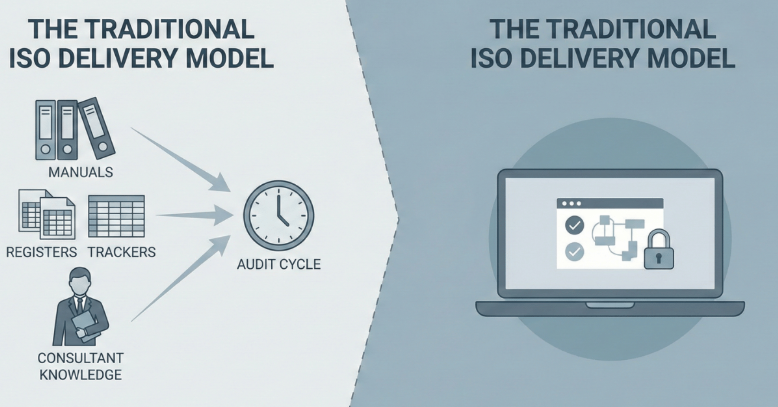
Conventional ISO delivery follows a predictable pattern. Consultants assess gaps, create documents, populate registers, and prepare organisations for audit. Once certification is achieved, ongoing maintenance is left to internal teams who often lack the time, tools, or context to sustain the system.
This model relies heavily on:
Manual procedures and static manuals
Disconnected registers and trackers
Consultant-owned knowledge
Audit-driven activity cycles
Over time, this creates dependency. Organisations rely on external support to interpret standards, update documentation, and defend systems during audits. Internally, teams struggle to engage with materials that feel abstract, repetitive, or disconnected from their actual work.
In high-risk industries, this gap between documented intent and operational reality becomes more than inefficient — it becomes dangerous. Controls exist on paper but are not embedded in behaviour. Risks are “managed” in registers but not actively monitored. Lessons are recorded but not systematically applied.
The system looks complete, but it doesn’t function.
Why ISO Projects Fail After Certification
The failure of traditional ISO projects is rarely the result of poor intent or lack of effort. In most cases, it is structural.
Projects are designed to end. They have defined scopes, timelines, and deliverables. Operating systems do not. They are designed to run continuously, absorbing change and maintaining stability as conditions evolve.
When ISO is treated as a project, success is measured by a single milestone: certification. Once that milestone is reached, attention naturally shifts back to operational priorities. The consultants exit. Internal focus dissipates. Registers are no longer actively maintained. Reviews are postponed. Ownership becomes diffuse.
What remains is a system that looks complete but lacks momentum.
Without embedded workflows, automated oversight, and visible accountability, ISO systems begin to degrade quietly. Controls still exist, but they are no longer actively exercised. Data is still collected, but it is not consistently reviewed. Risks are still documented, but they are not continuously reassessed as work changes.
This degradation often goes unnoticed until the next audit approaches. At that point, activity surges. Documents are updated. Evidence is assembled. Gaps are patched. The organisation passes again — but only through concentrated effort rather than system reliability.
Each audit cycle becomes an exercise in reconstruction rather than review.
This is why many organisations encounter the same findings repeatedly across certification cycles. The documentation changes. The templates evolve. The language improves. But the underlying system — how work is planned, controlled, monitored, and improved — remains largely unchanged.
Certification is achieved. Capability is not sustained.
Designing ISO as an Operating System
A modern ISO system must be designed the same way strong organisations are designed — around workflows, feedback loops, and visibility rather than static documentation.
An operating-system-based ISO approach starts by recognising that people cannot be expected to remember compliance. The system must guide behaviour. Processes must lead action. Oversight must occur naturally as part of work, not as a separate administrative activity.
Instead of asking staff to recall policies, the system presents the right information at the point of decision. Instead of asking managers to compile reports, dashboards surface performance automatically. Instead of delivering training once and hoping it sticks, learning is embedded directly into processes where it is needed.
This approach shifts ISO from a parallel framework into the core operating rhythm of the organisation.
Key characteristics of an operating-system-based ISO model include:
Diagrammatic processes rather than lengthy manuals, allowing teams to understand workflows quickly and apply them under real-world conditions
Micro-learning delivered at the point of need, reinforcing correct behaviour without disrupting operations
Live dashboards replacing static reports, giving leadership continuous visibility rather than periodic snapshots
Integrated audits rather than isolated events, validating system performance as work occurs rather than retrospectively
Continuous evidence generation built into operations, removing the need for last-minute audit preparation
In this model, ISO no longer competes with operations for attention. It supports them.
Evidence is generated as a by-product of doing the work properly. Reviews are informed by real-time data. Risks are managed as they emerge, not after they escalate. Accountability is visible, traceable, and consistent across teams and sites.
ISO becomes part of how the organisation works — not something it works around.
When designed as an operating system, ISO holds its shape under pressure. It adapts as the organisation grows. And most importantly, it continues to function long after the certificate is issued.
That is the difference between passing an audit and building capability.
From Compliance Activity to Operational Rhythm
When ISO systems are designed as operating systems, they integrate naturally into the rhythm of the business.
Risk identification becomes an ongoing activity rather than an annual exercise. Incidents feed directly into corrective action workflows. Management reviews draw from live data rather than manually compiled reports. Internal audits validate system performance rather than uncovering long-standing gaps.
This shift fundamentally changes how organisations experience ISO. Compliance no longer requires extraordinary effort. Audit readiness becomes a constant state rather than a last-minute scramble.
Most importantly, leadership gains visibility without micromanagement.
Why This Matters for Construction and Industrial Sectors
This systems-led approach is increasingly sought after by organisations engaging a Brisbane ISO Consultant, Sydney ISO Consultant, or Melbourne ISO consultant who are moving beyond checklist-based compliance models. Across these markets, businesses are recognising that certification alone is no longer sufficient — auditors, clients, and regulators now expect evidence of integrated, operationally embedded management systems rather than static documentation.
Industries such as construction, manufacturing, engineering, fit-out, fire protection, and distribution operate under constant change. Projects evolve. Sites change. Teams rotate. Risks shift daily. Documentation-heavy ISO systems cannot keep up with this pace, as they assume stability where none exists and rely on updates that lag behind operational reality.
By contrast, a digital ISO Management System adapts with the organisation. Controls move with the work, accountability follows responsibility, and leadership gains clear visibility into system health across multiple sites and activities. For organisations working with an ISO Consultant in Brisbane, Sydney, or Melbourne, this results in reduced audit disruption, stronger internal adoption, and ISO systems that scale with growth rather than resisting it.
Redefining the Role of the ISO Consultant
Treating ISO as an operating system also changes the role of the ISO Consultant.
Instead of acting as document authors or audit translators, consultants become system architects. Their role shifts toward designing frameworks that organisations can operate independently, confidently, and consistently.
Knowledge is embedded in the system rather than held by individuals. Capability remains within the organisation rather than walking out the door after certification.
This is a fundamental departure from traditional consulting models — and a necessary one for organisations seeking sustainable governance rather than recurring remediation.
Doing ISO Differently Is About Alignment, Not Technology
Doing ISO differently is not about technology for its own sake. It is about aligning governance with reality.
Technology is simply the enabler. The real shift is conceptual: from static compliance to dynamic capability, from documentation to behaviour, from audit preparation to operational confidence.
When ISO systems are designed as operating systems, certification becomes a checkpoint — not the objective. The real outcome is organisational resilience: systems that hold up under pressure, evolve with change, and support leadership decisions without constant intervention.
The Future of ISO Implementation
The future of ISO implementation is not heavier documentation, more templates, or larger manuals. It is smarter systems designed to reflect how organisations actually operate.
ISO standards provide the framework. Operating systems bring them to life.
Organisations that embrace this shift move beyond certification projects and build governance structures that scale with confidence rather than collapsing under complexity. They stop chasing audits and start using ISO as it was intended — as a foundation for sustainable performance.
This is why we’re doing ISO differently. Not to reinvent the standard, but to finally implement it in a way that works.
Written by Kandace Swaisland
January 19, 2026