
The Founder Trap: What Made You Successful at $500K Will Actively Harm You at $5M
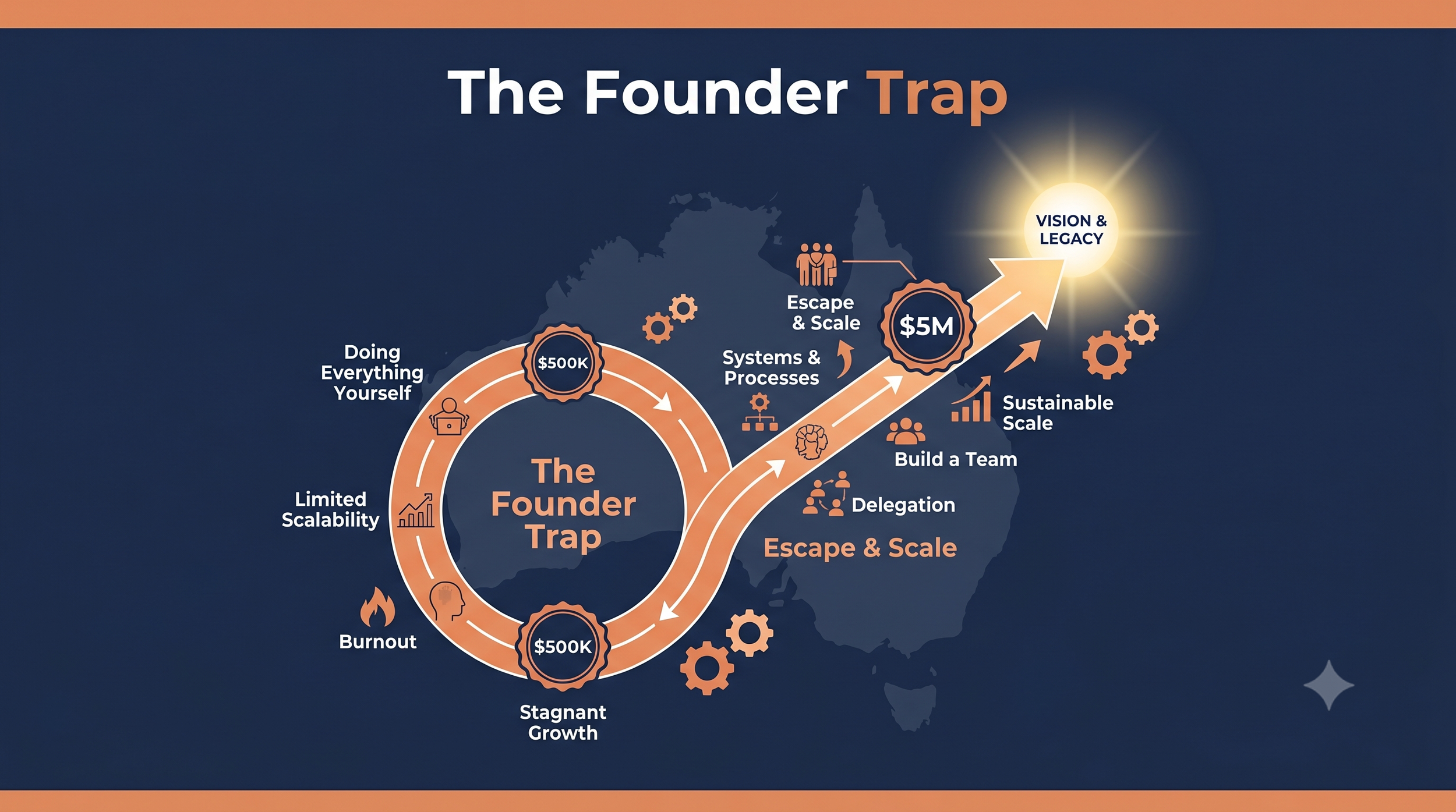
There is a threshold in every scaling business.
It is not always obvious when you cross it. Most founders do not notice it happening. They are busy running the business, managing clients, solving problems, winning the next contract. The same behaviours that built the company from nothing are still producing results. Why would anything need to change?
And then, somewhere between the business that felt manageable and the one they are running now, something starts to drag.
This is the founder trap. It catches almost everyone who builds a business past a certain point. Not because they lack ambition or capability, but because the skills that make a great founder at $500K are genuinely different from the skills that make a great leader at $5M.
What the Founder Trap Actually Looks Like
The founder trap is not a dramatic event. It is a slow compression.
1. In the early years
The founder’s direct involvement in everything is the point.
They know the clients personally. They can produce the work themselves. They hold the relationships, the institutional knowledge, and the quality standard all in one person.
At $500K, this is not a weakness. It is the model. The business is the founder, and the founder is the business.
2. When growth adds volume without architecture
The problems begin when growth adds volume without adding architecture.
● More clients means more client management
● More staff means more communication, more delegation, more accountability
● More contracts means more risk, more compliance, more complexity at every level
But the decision-making infrastructure has not changed. It still runs through one person, because that is how it has always worked, and the business grew on the back of it.
What happens next is predictable. The founder becomes the bottleneck.
3. The bottleneck in practice
● Decisions that should be made by team members sit in a queue waiting for the founder’s attention
● Problems that should be resolved by a documented process get escalated because there is no documented process
● Quality that should be consistent across every job varies because the standard lives in the founder’s head rather than in the system
The business keeps generating revenue. The founder keeps working. But the founder is working harder to sustain the same result, and often a worse one, than they achieved at a smaller scale.
That is the trap.
Why the Skills That Built the Business Stop Working
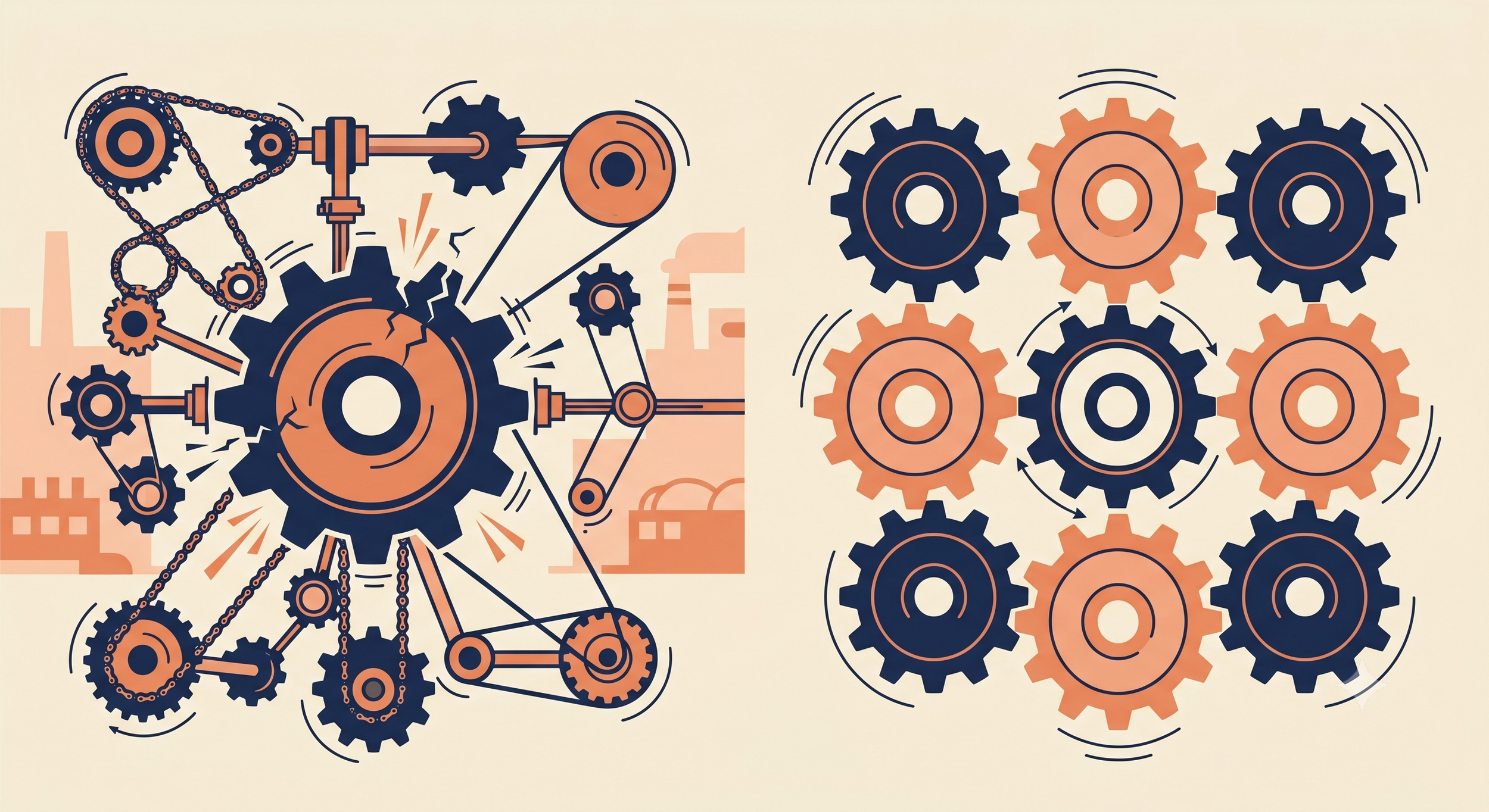
Chasing big is how founders accidentally destroy the thing they built.
Not through bad decisions. Through good decisions made for the wrong version of the business.
1. Personal quality control
At $500K, the founder’s instinct to personally manage quality is a competitive advantage. They can see every job. They know every client. They catch problems early because they are close to the work.
At $5M, that same instinct becomes a constraint. The founder cannot see every job. There are too many clients. Catching problems by being personally present is no longer possible.
Trying to maintain that level of involvement creates a business where nothing can happen without the founder. Which means nothing can scale.
2. Fast, instinctive decision-making
Invaluable in the early stages.
At scale, it becomes a liability if decisions are not documented, not consistent, and not teachable to the team.
The founder who can hold ten projects in their head and move between them without a formal system is impressive. Until the business has forty projects, and then that strength becomes the single biggest operational risk the organisation carries.
3. The informal communication style
It made the team feel like a family at five people.
At twenty people, it creates confusion and resentment, when people at different levels of the organisation have genuinely different information about what is happening and what is expected.
None of these founder qualities are bad. They are the raw material of a successful business. The challenge is that scaling requires building infrastructure that captures and distributes these qualities rather than concentrating them in one person.
What the Threshold Actually Requires

Crossing the threshold from founder-dependent to system-dependent is not about the founder stepping back.
It is about the founder stepping into a different role.
1. The standard must live in the system
The founder who understands quality still needs to set the standard. But the standard needs to live in the management system, not in the founder’s presence.
Every time the founder personally catches a quality issue that should have been caught by a documented process, they are creating two problems. They are solving the immediate issue. And they are deferring the real problem, which is that the system does not work without them.
2. Why ISO 9001 matters here
This is why ISO 9001, implemented properly, is so consequential for scaling businesses.
Not because it is a certificate. Because the process of building a genuine quality management system forces a business to externalise what the founder knows.
● Documented procedures
● Monitoring metrics
● The internal audit cycle
● The corrective action process
These are the mechanisms by which founder knowledge becomes organisational knowledge.
3. The same logic applies to safety
ISO 45001 requires the organisation to identify hazards, assess risks, and implement controls systematically.
Not because the founder cannot do this intuitively. Because the founder cannot do it at two in the morning when a site incident occurs and they are three hundred kilometres away.
The management system is not a bureaucratic imposition. It is the infrastructure that makes the founder’s continued involvement possible at scale, in a form that does not require their physical presence in every decision.
The Decisions That Have to Be Made
Getting through the founder trap requires some decisions that feel uncomfortable before they feel correct.
1. Deciding to build what is not yet needed
The hardest part of building infrastructure for the next level of scale is that it costs time and resources at the current level where nothing is broken.
The processes that will protect the business at $5M take weeks to implement at $2M. Most founders defer this until the problem is urgent, which means implementing it under pressure, with less time, and with more disruption.
2. Deciding that team capability matters more than founder control
The transition from founder-as-doer to leader-as-architect requires genuine investment in the team’s capability to make good decisions without the founder present.
This is not a philosophical shift. It is a structural one. It requires documented standards, clear authority, regular review, and a willingness to let the team make and learn from decisions that the founder could have made better.
3. Deciding what the business is actually for
This is the question underneath the founder trap.
A business that requires the founder to personally sustain it is not a business. It is a job with overhead.
The businesses that navigate this threshold successfully are usually the ones where the founder has a clear picture of what they are actually building, and why size is not the answer by itself.
There Is a Version of This That Works
Founders who hit the revenue number and were miserable are more common than the entrepreneurial narrative suggests.
The story that gets told is about breaking through, about the hard years paying off, about the business finally hitting the number that was always the goal.
What the story leaves out is the number of founders who hit that number and found themselves running something they no longer recognised. Or no longer wanted to run.
The version that works
● A business that grows in a way that builds the founder’s freedom rather than consuming it
● Revenue generated in proportion to the system’s capability rather than the founder’s hours
● A business that can operate without the founder being physically present, because the infrastructure exists to carry the load
That is not a bigger business. That is a better one.

The next article in this series examines one of the most common structural problems inside scaling businesses: the confusion between bureaucracy and infrastructure, and why getting this distinction wrong costs businesses far more than they realise.
If you are at the threshold and recognising some of what is described here, KAKSCORP offers a complimentary strategy call. We will give you a straight answer on where the architecture gaps actually are, with no obligation.
