
Bureaucracy vs Infrastructure: How to Tell the Difference Inside Your Own Business
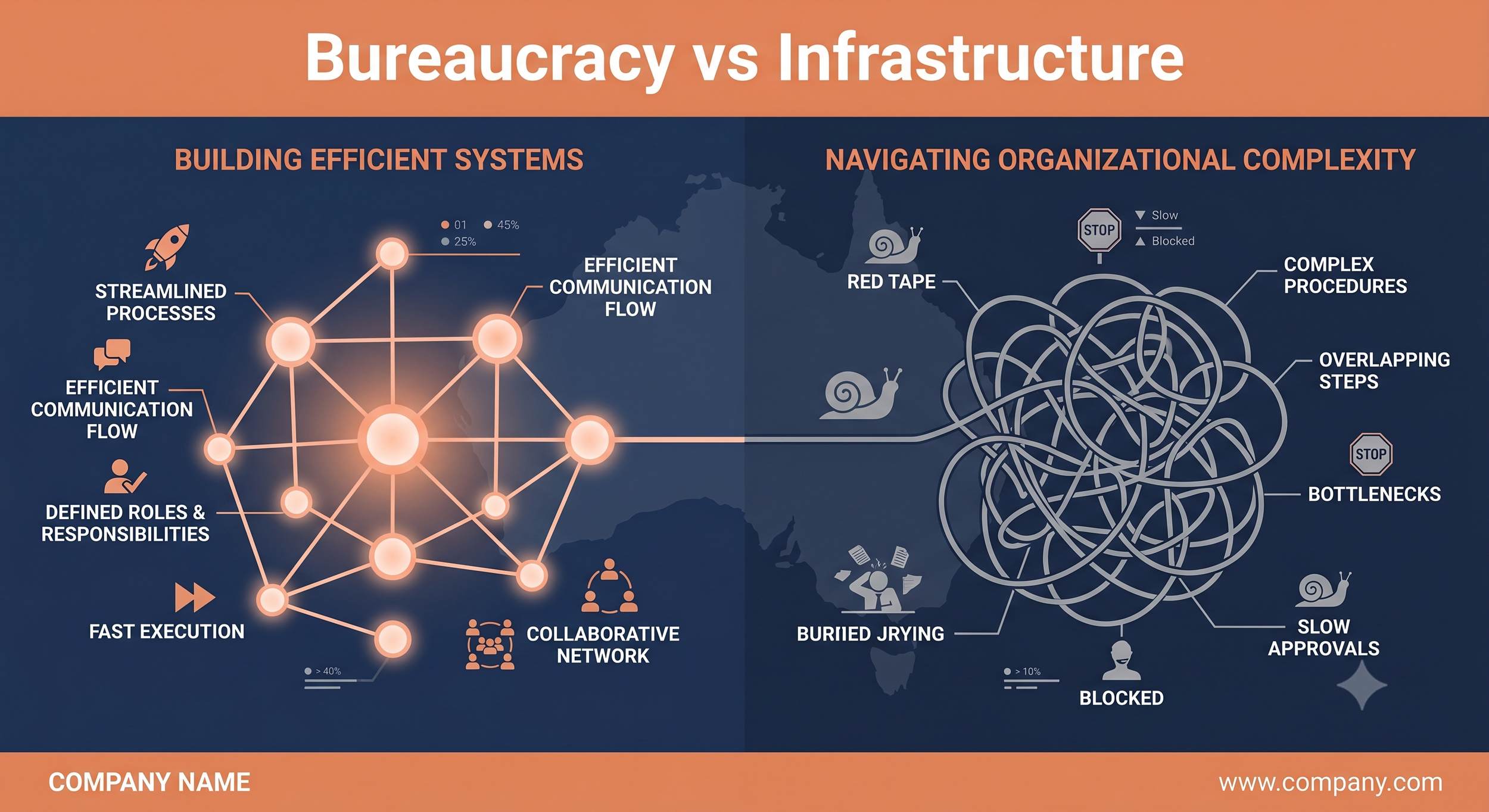
Bureaucracy and infrastructure look the same from the outside.
Both involve documented procedures. Both require sign-offs. Both produce paperwork. Both slow you down before they speed you up. From a distance, the two things are almost indistinguishable.
From the inside, they are completely different. One protects the business. The other consumes it.
This distinction matters enormously for scaling businesses, because the same organisation can have elements of both running simultaneously. Most do. And the failure to distinguish between them is responsible for two of the most common scaling mistakes we see:
● Businesses that build bureaucracy in the name of infrastructure
● Businesses that strip out infrastructure in the name of agility
What Infrastructure Actually Does
Infrastructure is the system architecture that allows the business to do more without proportionally increasing complexity.
1. A quality management system is infrastructure
When it is genuinely implemented, it means every delivery team follows the same process for checking work before it leaves the business.
● Problems get identified at the point they are cheapest to fix, not at the point the client raises them
● A new team member can be trained to the standard because the standard is documented, not because they shadow the right person until they absorb it
2. A safety management system is infrastructure
● A site hazard gets logged and actioned through a consistent process rather than depending on whoever happens to notice it
● The business can demonstrate to a client, a regulator, or a tribunal exactly what it did to protect its people, because the records are there and they are genuine
3. An onboarding process is infrastructure
Not because compliance requires it.
Because when the same person has to explain the same things to every new team member from scratch, that is a fixed cost per hire that never reduces. When the process is documented, refined, and maintained, that cost goes down with every subsequent hire.
The test
Does it make the business better over time, regardless of which individuals are in the roles?
If the answer is yes, it is infrastructure. If the answer depends on specific people being present and engaged, it is either not yet infrastructure or it is bureaucracy dressed up as it.
What Bureaucracy Actually Does

Bureaucracy is process that exists for process’s sake.
It adds steps without adding value. It requires approvals that nobody reads before they give them. It produces documentation that gets filed and never used. It creates friction for the team without creating clarity, accountability, or protection for the business.
1. The most common source in Australian businesses
Compliance work that was built to satisfy an external requirement rather than to actually operate.
● The ISO management system that was implemented to pass the audit and never touched again
● The safety procedures that exist as a PDF on the intranet and have never been read by the people they supposedly govern
● The environmental register that was populated once and not updated since the regulation changed two years ago
These are not management systems. They are theatre. And they carry most of the cost of infrastructure with almost none of the benefit.
2. Approval chains that exist for political reasons
When a decision requires three sign-offs not because three people’s expertise is genuinely needed but because three people need to feel consulted, the organisation is producing bureaucracy.
It is using process to manage internal relationships rather than to protect the business or improve outcomes.
3. Reporting that nobody acts on
● Monthly reports that get emailed to a distribution list and never discussed
● KPIs that get measured and recorded but have no connection to decisions
● Data that exists to demonstrate activity rather than to inform direction
This is bureaucracy at scale, and it consumes genuine resources.
4. Process duplication across teams
When two parts of the same business have developed their own versions of the same process because the central process did not meet their needs, both the central process and the workarounds are probably bureaucracy.
Real infrastructure gets used. Bureaucracy gets worked around.
Why the Confusion Happens
The confusion between bureaucracy and infrastructure is almost universal in businesses that add structure quickly.
1. The timing problem
Businesses that implement management systems under pressure, to meet a contract requirement or satisfy an audit, often build documentation and process without building the cultural and operational habits to make those systems live.
The systems look like infrastructure. They are structured like infrastructure. But they run like bureaucracy because nobody genuinely uses them.
2. The over-formalisation problem
The other direction is also common. Businesses that had genuine, effective informal processes try to formalise them in ways that destroy what made them work.
● The quality instinct of a senior team member gets translated into a sixty-page procedure that nobody reads
● The safety awareness of a site foreman gets replaced by a reporting form that gets completed after the fact
The formalisation adds compliance risk management without adding any of the operational value that existed before it.
3. The common gap
In both cases, the process was not designed with the people who use it in mind.
Good infrastructure is built to make the right behaviour easier, not to document it. There is a meaningful difference between a procedure that tells a team member what to do and a system that makes doing the right thing the path of least resistance.
How to Tell Which One You Have

The practical test is to ask one question of every major process, system, or procedure in the business:
If we removed this tomorrow, would something get worse?
If yes, it is probably infrastructure. Something valuable depends on it.
If no, or if the honest answer is that you are not actually sure because nobody has checked recently, it is probably bureaucracy. It is consuming resources without producing outcomes.
The friction audit
A more rigorous version of the same test is to look at where the friction in the business actually comes from.
Not the friction between people, which is a culture and structure problem. The operational friction:
● The processes that slow delivery
● The sign-offs that create bottlenecks
● The documentation requirements that consume team time without producing commercial return
For every friction point, ask whether removing it would improve outcomes or expose a risk.
If it would expose a risk, you have found infrastructure that needs to work better. If it would just make people’s days easier without creating any downstream problems, you have found bureaucracy.
The ISO Question Specifically
ISO management systems are, by design, infrastructure.
The standards are built around continuous improvement, not static compliance. ISO 9001 requires the organisation to monitor processes, measure performance, review outcomes, and take corrective action.
That is not a documentation exercise. It is an operational cycle that, when it is running genuinely, makes the business demonstrably better over time.
Why ISO often feels like bureaucracy anyway
The reason so many Australian businesses experience their ISO systems as bureaucracy is not because the standards are badly designed.
It is because their implementation prioritised certification over operation. The management system was built to pass an audit rather than to run the business, and so passing the audit is all it does.
The businesses that get genuine return
They are the ones that built their systems to operate:
● The internal audit cycle produces real findings and real corrections
● Management review produces real decisions
● The corrective action process is used when something goes wrong rather than bypassed in favour of the informal conversation that has always worked before
Those businesses do not experience their management systems as bureaucracy. Because the systems are doing something useful every day.
Building Infrastructure, Not Bureaucracy
The practical implication for scaling businesses is to be deliberately discriminating about what you build and why.
Every process, system, or procedure should have a clear answer to two questions:
● What risk does this manage, or what outcome does this produce?
● How will we know if it is working?
If a process cannot answer both questions, it is probably bureaucracy, or it is infrastructure that has not been connected to the business. Either way, it needs attention before it scales.
Great businesses are not businesses with fewer processes. They are businesses where every process does something real.

The final article in this series examines what the Elysian work environment actually looks like from the inside: the practical experience of working in and running a business that has been built right rather than just built fast.
If you want to understand where the real infrastructure gaps are in your business, KAKSCORP offers a complimentary strategy call. We will give you a straight answer, with no obligation.
