
The Elysian Work Environment: What a Great Business Actually Feels Like From the Inside
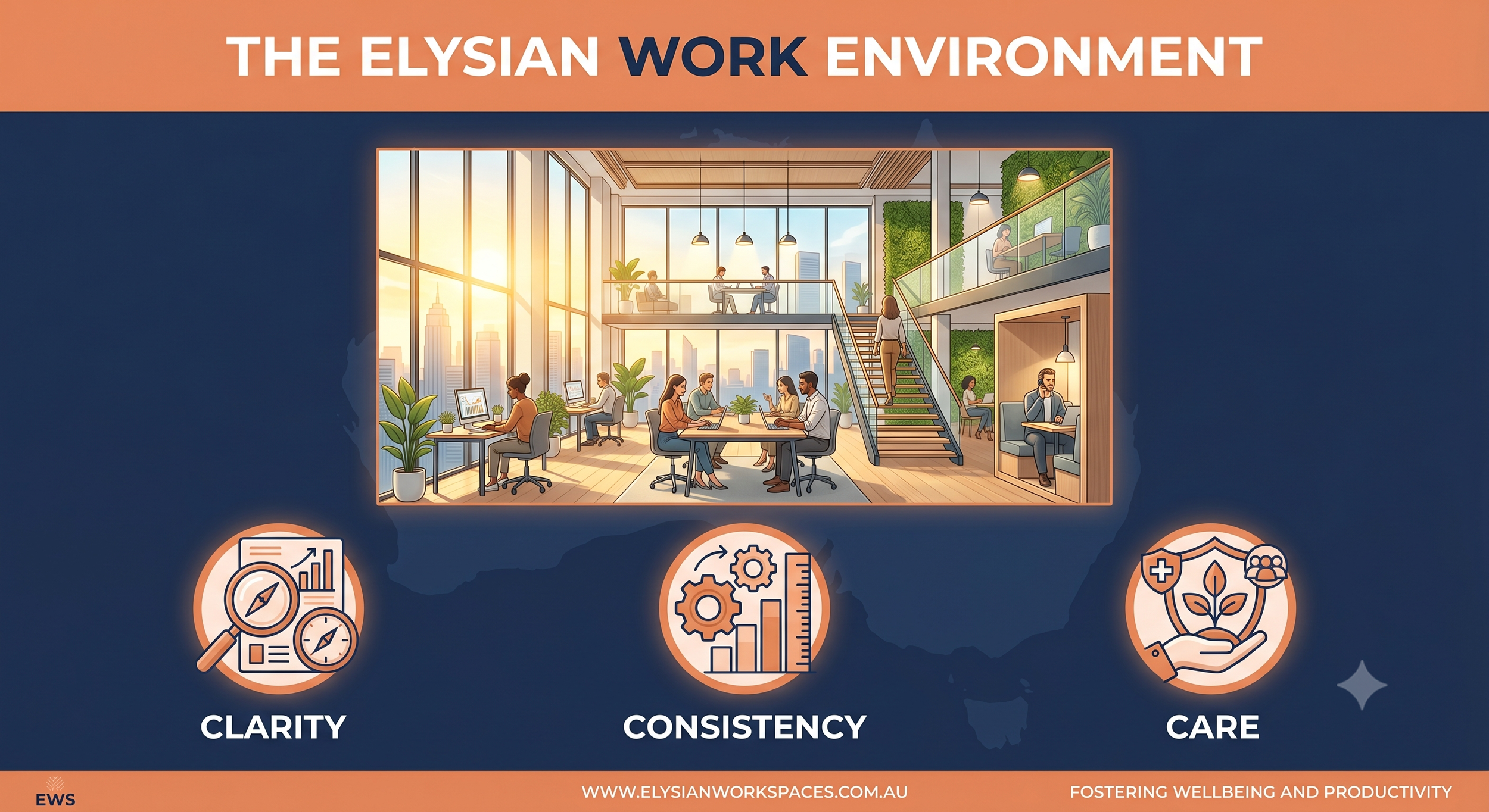
The phrase "Elysian work environment" comes from Greek mythology.
Elysium was the place reserved for those who had lived well. Not extravagantly. Not powerfully, necessarily. But well. With purpose and quality and a genuine sense of having done something that mattered.
KAKSCORP uses this phrase deliberately, because the work environment we are describing when we talk about great business is not a luxury. It is not a benefit package or a perks program or a set of aspirational values on a wall. It is a specific organisational condition that is achievable, practical, and directly connected to how well the business is built.
This is the final article in Campaign 1 of our series, and it is the most personal one. The previous three examined what greatness means for a business, how the founder trap develops, and how to distinguish real infrastructure from bureaucratic noise. This one is about what it feels like when you get it right.
What the Elysian Work Environment Is Not
It is worth clearing away some common misreadings before describing what this actually is.
1. It is not a workplace wellness program
It is not about yoga at lunch or flexible Fridays or any arrangement that addresses symptoms of a poorly built organisation while leaving the underlying structure intact.
A business with a broken management architecture does not become an Elysian work environment because it adds a massage chair to the break room.
2. It is not a culture of enforced positivity
Cultures that require people to perform satisfaction are often the most brittle.
The appearance of a great environment and the reality of one are not the same thing, and the gap between them tends to widen under pressure.
3. It is not exclusive to large organisations
Some of the businesses closest to this condition are small. Some are in industries not typically associated with it: construction, logistics, facilities management, food manufacturing.
The size and sector matter less than the quality of the operational and management architecture.
4. It is not a destination
It is a sustained condition that requires ongoing maintenance.
Businesses that build toward it and then stop maintaining it find that the condition degrades, usually gradually and then suddenly, in exactly the way that neglected management systems do.
What It Actually Feels Like

The clearest sign that a business is approaching the Elysian work environment is that problems are ordinary.
Not rare. Not catastrophic. Ordinary.
Problems in a well-built business
Problems occur in every business. The question is whether the organisation encounters them as emergencies or as normal events within a managed system.
A business that has built genuine infrastructure treats a client complaint, a safety incident, or a compliance gap as a data point that feeds back into the improvement cycle. The event happens, the process engages, and the business gets slightly better at preventing the same event in future.
Problems in a poorly built business
A business that has not built that infrastructure treats every significant problem as a crisis, because there is no containing architecture.
Each problem lands directly on whoever happens to be nearest to it, usually the founder or a senior team member, and consumes resources in proportion to its severity rather than being absorbed by a system designed to handle it.
The experience of problems as ordinary rather than catastrophic is not trivial. It is probably the single most significant practical difference between a well-built business and a poorly built one.
The People Experience
In a business with genuine operational infrastructure, people know what is expected of them.
This sounds simple. It is not common.
Role clarity is rarer than leaders think
Many businesses have job titles, informal expectations, and a general sense of who does what.
But genuine role clarity, where a team member knows precisely what decisions they are authorised to make, what their quality standard is, and how their performance will be assessed, is significantly less common than most leaders think.
What happens when clarity exists
When people know what is expected and have the systems to deliver it, several things happen:
● They make better decisions, because the standard is clear
● They escalate appropriately, because the lines of authority are defined
● They develop confidence, because they can measure their own performance against a clear benchmark
● They stay
Retention is about environment, not just pay
People leave businesses where nothing is clear, where problems constantly escalate to whoever is most senior, where quality depends on whoever is having a good day, where leadership decisions seem arbitrary because they are not connected to a documented system.
They stay in businesses where the architecture makes it possible to do good work consistently.
That is the people experience in an Elysian work environment. Not extraordinary. Not curated. Simply: clear, consistent, and capable of sustaining good work.
The Founder Experience

The founder’s experience in a well-built business is qualitatively different from the founder’s experience in a fast-built one.
The most immediate difference is headspace
When the operational systems are running well and genuinely embedded, the founder is not required to hold everything.
● Problems do not all arrive at the same destination
● Decisions are made at the level where they actually belong
● The management review cycle produces real information rather than performance of compliance
The founder can think about the direction of the business rather than being consumed by its daily operation.
This is not retirement
The founder still matters enormously.
Their judgement, their relationships, their vision for what the business is building toward. These are the things that a well-built operational architecture releases the founder to focus on, rather than the things it replaces.
The misery problem, revisited
Founders who hit their revenue target and found themselves miserable were usually experiencing the absence of this architecture.
The revenue was there. The founder satisfaction was not, because the business had grown in ways that multiplied the founder’s operational burden rather than reducing it. More revenue, more problems, more decisions landing on the same person.
That is not what building a great business looks like.
Building a great business looks like growing in a way that compounds advantage rather than complexity. Where each improvement to the system makes the next level of scale more accessible, rather than creating a new set of problems to solve before growth can continue.
The Client Experience
From a client’s perspective, the Elysian work environment manifests as reliability.
Not perfection. Reliable delivery, reliable communication, and when things go wrong, a reliable process for identifying what happened and fixing it.
What clients actually expect
Clients do not expect perfection from complex service businesses.
They expect that the business they are working with has the operational maturity to deliver consistently and to handle problems professionally when they occur.
Where ISO fits
ISO certification, implemented genuinely, is one of the clearest operational signals of this capability.
The certificate itself matters for tender qualification. But the underlying management system is what produces the client experience that retains the relationship after the contract is won.
The businesses that win contracts and keep them, that build the kind of client relationships where they are the first call rather than one of three quotes, have usually built operational systems that make consistent delivery possible regardless of individual variation in their team.
● They have documented their standards
● They monitor their performance
● They review and improve continuously
That is not a compliance exercise. That is the operational foundation of a great client relationship.
Building Toward It
The Elysian work environment is not built in a single engagement.
It is built by making a series of decisions over time that consistently favour the quality of the architecture over the convenience of the shortcut:
● Implementing the management system that actually runs rather than the one that just certifies
● Building the team capability that distributes good decision-making rather than concentrating it
● Designing the processes that make right behaviour easy rather than documenting the processes that enforce it
Each of these decisions is individually small. Collectively, they are the difference between a business that is merely big and one that is genuinely great.

This quarter’s campaign series has been about establishing that distinction clearly. Not as an abstract ideal, but as a practical description of what KAKSCORP’s work is designed to build toward.
If you are building a business and you want to understand what the practical path from where you are to where you want to be actually looks like, KAKSCORP offers a complimentary strategy call. We will give you a straight answer, with no obligation.
