
The Gap Between ISO Certification and Real-World Quality, Safety and Environmental Performance
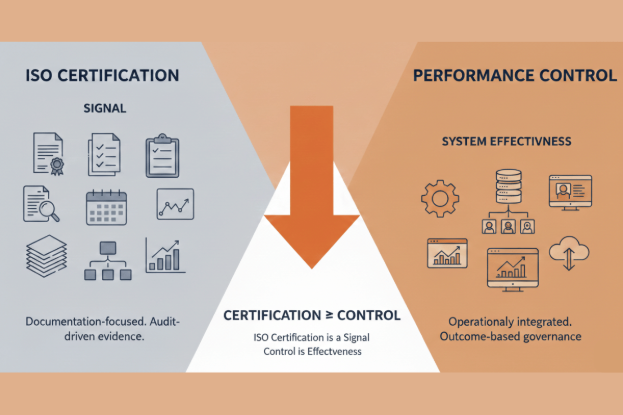
In many organisations, ISO certification is treated as a finish line. It becomes a symbol of maturity, a signal to clients, regulators, and stakeholders that the business has control. The certificate is framed, included in tenders, and referenced in governance conversations as evidence that the organisation is “managed.”
Yet the uncomfortable reality is that ISO certification does not always translate into real-world quality safety environment performance.
This is not a criticism of the ISO standards themselves. ISO 9001, ISO 45001, and ISO 14001 were never designed to be administrative exercises. They are leadership frameworks. They exist to strengthen how organisations plan, govern, control, review, and improve. They are meant to make performance reliable under pressure, not simply presentable during audit.
The gap appears when certification becomes the objective, rather than the outcome of a controlled operating system.
ISO Certification Is a Signal, Not a Control Mechanism
It is worth being clear about what ISO certification actually represents.
ISO certification confirms that an organisation has implemented a documented management system that meets the requirements of the standard, and that it has demonstrated evidence of this system through audit.
It does not confirm that the system is effective in the way leaders often assume.
This distinction matters, because leadership teams frequently interpret certification as proof of governance strength. In board settings, certification is often spoken about as a risk mitigator in itself. The assumption is that certification equals control.
But being certified is not the same as being controlled.
Control means risks are actively managed as work unfolds. It means performance is predictable across sites, teams, and changing conditions. It means accountability is visible, decision-making is structured, and management review is a real governance activity rather than an annual compliance routine.
ISO certification can exist without those outcomes. And in many organisations, it does.
Why the Gap Exists: Certification Measures Structure, Not Behaviour
The ISO standards define what a management system must include. They do not guarantee how that system will be used.
This is where the gap between ISO certification and management system effectiveness becomes most visible.
A system can be structurally compliant, yet operationally weak. It can contain all required procedures, registers, and policies, yet still fail to influence how decisions are made day to day. It can generate evidence, yet fail to generate control.
This happens when the management system becomes an artefact rather than an operating model.
In other words, the system exists, but it is not driving the organisation. It is being maintained alongside it.
Leaders often assume that if documentation exists and audits are passed, performance must be stable. But many failures in quality, safety, and environmental outcomes occur inside certified organisations. The certificate did not prevent the incident. It did not prevent the defect. It did not prevent the environmental breach.
The system may have been present, but it was not governing.
ISO Governance Is Not Documentation Governance
A key reason this gap persists is that organisations often confuse documentation control with ISO governance.
Documentation governance is about ensuring documents are current, approved, and accessible. It is a necessary component of any management system, but it is not the core.
ISO governance is broader and more demanding. It is about how leadership ensures that the organisation is operating within defined controls, that risks are understood, and that performance is reviewed with intent.
ISO governance asks questions such as:
Are risks being actively monitored, or only recorded?
Are controls embedded in workflows, or only described in procedures?
Are corrective actions closing systemic issues, or simply closing audit findings?
Is management review shaping decisions, or just producing minutes?
These are leadership questions. They are not administrative ones.
When ISO is treated as an audit deliverable, governance is reduced to paperwork. When ISO is treated as a leadership framework, governance becomes operational.
Certified Does Not Mean Controlled
The most important distinction senior leaders must make is this:
Certification is evidence of implementation. Control is evidence of effectiveness.
An organisation can be certified while still operating in a way that is dependent on individual judgment, informal decision-making, and inconsistent execution. It can be certified while still lacking clear accountability across quality, safety, and environmental risk.
This is where many systems quietly fail. They do not fail at audit. They fail in the moments that matter.
For example, quality outcomes may depend heavily on experienced supervisors catching issues early rather than on reliable process controls. Safety performance may rely on strong individuals driving culture rather than on systems that enforce consistency across teams. Environmental performance may be treated as reporting rather than operational decision-making.
The organisation may appear compliant, yet the system is not actually carrying the load.
When leadership assumes certification equals control, they often stop asking the harder questions. That is where governance weakens.
The Leadership Role in ISO 9001, ISO 45001 and ISO 14001
ISO 9001, ISO 45001, and ISO 14001 all place explicit responsibility on leadership.
This is not accidental. ISO standards are built on the idea that performance outcomes are shaped by leadership intent, accountability, and review. They are not meant to be delegated entirely to compliance teams.
The standards require leadership to demonstrate:
Direction and alignment
Accountability and responsibility
Resource allocation
Risk-based thinking
Oversight through management review
Commitment to continual improvement
This is where ISO becomes strategic.
It is not a framework for creating documents. It is a framework for governing performance. Leaders are expected to treat quality, safety, and environmental management as operational disciplines, not as audit tasks.
When leadership treats ISO as a checkbox, the system becomes passive. When leadership treats ISO as governance, the system becomes active.
Why Management System Effectiveness Matters More Than Compliance
Most organisations can achieve compliance.
Many can pass certification audits.
Far fewer can demonstrate management system effectiveness in real-world conditions.
Effectiveness is visible when the system continues to function under stress. When sites change, when projects scale, when teams rotate, when workloads increase. When conditions become less predictable, not more.
This is exactly when quality failures, safety incidents, and environmental breaches are most likely to occur.
An effective system does not prevent every failure. But it ensures failures are detected earlier, contained faster, and corrected in a way that strengthens capability rather than just closing findings.
This is the difference between compliance and control.
A compliance system produces documentation. A control system produces predictable performance.
The Role of Management Review as a Governance Mechanism
Management review is one of the most underestimated requirements in ISO standards.
Many organisations treat it as a formal meeting. An agenda item. A set of minutes. A compliance checkpoint to satisfy auditors.
But in reality, management review is intended to be a governance mechanism.
It exists so leadership can assess:
whether the system is still fit for purpose
whether risks have changed
whether controls are functioning
whether performance is improving or drifting
whether accountability is clear
In a mature organisation, management review is not a meeting held because ISO requires it. It is held because governance requires it.
This is where leadership accountability becomes real.
When management review is treated seriously, it becomes one of the most valuable leadership routines in the business. It connects operational reality with strategic oversight. It ensures the organisation is not relying on assumptions.
When it is treated lightly, the system becomes fragile.
The Organisational Cost of Mistaking Certification for Control
When leadership assumes ISO certification equals real-world performance control, several risks emerge.
First, the organisation develops blind spots. Leaders believe risks are managed because registers exist. They believe controls are embedded because procedures exist. They believe corrective actions are working because findings are closed.
Second, accountability becomes unclear. Teams begin to treat ISO as the responsibility of a few individuals rather than as a shared operating model. The system becomes something that sits beside operations rather than inside them.
Third, performance becomes inconsistent. Quality, safety, and environmental outcomes vary across sites, projects, or teams, even though the organisation remains certified.
This inconsistency is often tolerated until something goes wrong. Then, suddenly, the system is questioned.
At that point, the organisation typically responds by strengthening documentation, increasing audit activity, or adding new registers. But those responses rarely address the root issue, which is system design and governance.
The gap widens not because people are careless, but because the operating model is misaligned.
ISO Standards as Leadership Frameworks
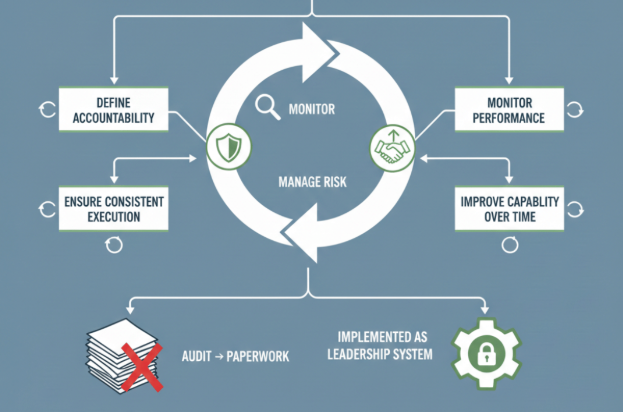
If ISO 9001, ISO 45001, and ISO 14001 are understood correctly, they represent something far more valuable than certification.
They represent leadership frameworks.
They provide a structured way for leaders to:
define accountability
manage risk
ensure consistent execution
monitor performance
review system health
improve capability over time
This is why ISO standards remain relevant across industries and across decades. Their intent is not administrative. It is operational and strategic.
The problem is not the standards. The problem is how they are often implemented and governed.
When organisations treat them as audit checklists, they get paperwork. When organisations treat them as leadership systems, they get control.
Closing the Gap: From Certified to Controlled
The gap between ISO certification and quality safety environment performance is not inevitable.
It exists because organisations sometimes build systems to satisfy external validation rather than internal governance.
In governance-focused organisations, certification should be seen as a checkpoint. It confirms that a framework exists. It does not confirm that the framework is effective in the way leadership requires.
Real-world control comes from management system effectiveness, leadership accountability, and governance routines that reflect how the organisation actually operates.
ISO certification matters. But it is not the goal.
The goal is capability.
The goal is control.
And ultimately, the goal is performance that holds up in real conditions, not just during audit.