
Digital ISO Systems: Why Software Alone Doesn’t Fix Quality, Safety or Environmental Risk

Most organisations do not invest in ISO technology because they are excited about new software. They do it because their existing approach has become hard to maintain. Registers are scattered. Actions get lost in inboxes. Audit preparation becomes a recurring panic cycle. Over time, the ISO system begins to feel like something the organisation carries, rather than something that supports its operations.
It is understandable that leaders begin considering digital tools and thinking, “This will fix it.”
In some cases, it does.
But in many cases, it does not. And when it fails, it fails quietly. The organisation still looks compliant. The platform still contains records. Dashboards still show activity. Yet the same issues remain underneath. Quality outcomes stay inconsistent. Safety incidents still occur. Environmental risk is still managed late rather than early.
This is why digital ISO systems often underperform. Not because software is inherently flawed, but because organisations expect tools to solve problems that are actually caused by system design.
The Most Common Mistake: Digitising Documents Instead of Digitising the System
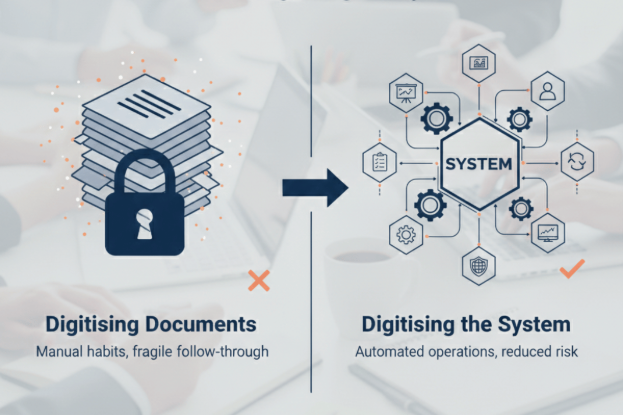
One of the biggest misconceptions in ISO implementation is the belief that an ISO system is primarily a set of documents. When organisations move into digital tools, they often bring that assumption with them.
Policies get uploaded. Procedures are stored in a portal. Risk registers are transferred from spreadsheets into a database. Audit checklists become digital forms. Training records are logged automatically. Everything is now “in the system.”
But the operating model has not changed.
This is the point where many organisations confuse digitisation with improvement. They have digitised information, but they have not digitised management. The organisation is still relying on the same manual habits, the same informal decision-making, and the same fragile follow-through. The only difference is that the evidence now sits in a platform instead of a shared drive.
This is why digital ISO systems do not automatically reduce risk. Risk is not reduced by storage. It is reduced by how planning, execution, accountability, monitoring, and review happen in real operations.
What Digital ISO Systems Are Actually Meant to Achieve
When digital ISO is implemented properly, the goal is not to create a cleaner version of the paperwork. The goal is to strengthen execution. A digital system should support how people work, especially in environments where conditions change quickly and teams cannot rely on memory.
A well-designed system improves visibility. It clarifies responsibility. It strengthens follow-through. It makes the system easier to use during normal operations, not just during audit preparation.
This is the difference between a compliance tool and a management system.
A compliance tool stores evidence.
A management system shapes behaviour.
Most organisations do not need more evidence. They need more control.
Why Software Alone Does Not Fix Quality, Safety, or Environmental Performance
There is a reason so many digital transformations struggle in practice. Organisations buy tools expecting the tools to solve problems. But tools do not solve problems unless the organisation has a clear operating model for how those tools will be used.
Accountability is unclear, software will not automatically make it clear.
Actions are not followed through, software will not create discipline.
Risk assessment is inconsistent, software will record inconsistency faster.
This is why the idea of “just implementing ISO software” is often risky. It gives leadership the feeling that the system is now modern and controlled. Yet the organisation may still be operating with the same weaknesses, only now those weaknesses are hidden behind a digital interface.
In high-risk industries, this illusion is dangerous. It creates confidence without control. It creates activity without outcomes.
Why ISO 9001 Software Does Not Automatically Improve Quality
Quality issues rarely happen because an organisation lacked documents. Most organisations have procedures, checklists, and registers already. The real issue is that these tools are often disconnected from how work actually happens under pressure.
ISO 9001 software can be extremely useful, but it does not replace the need for a functioning ISO 9001 management system. Quality improves when processes are stable, responsibilities are clear, nonconformances are handled properly, and corrective actions are closed with real verification.
Many organisations digitise their quality documentation but leave the underlying workflow untouched. Nonconformances are still logged late. Root causes are recorded, but not acted on. Corrective actions are assigned but lose momentum. Quality issues become recurring because the system does not force learning into daily practice.
This is why quality outcomes do not change, even after a software implementation. The organisation becomes better at recording quality issues, but not better at preventing them.
Why ISO 45001 Digital Systems Still Allow Safety Incidents
The same problem appears in safety.
ISO 45001 digital systems often get implemented with the assumption that digitising safety processes will reduce incidents. But safety risk does not reduce because incident reports are digital, or because a hazard register looks more professional.
Safety risk reduces when hazards are identified early, controls are embedded into work planning, responsibilities are clear, and supervisors have real visibility into what is happening on site. Safety improves when actions are tracked properly, when verification is meaningful, and when learning is shared consistently across teams.
A digital tool can support this, but only if the system is designed to drive behaviour. If the tool is used mainly as a record-keeping platform, then it becomes a reporting system rather than a risk control system.
And reporting is not protection.
Why ISO 14001 Automation Can Become a Box-Ticking Machine
Environmental management is often where organisations see the most value in automation, because reporting can be repetitive and data can be difficult to manage across sites.
ISO 14001 automation can help streamline monitoring, improve data accuracy, and reduce manual reporting effort. But again, automation does not automatically improve environmental performance. It only improves the speed at which information is captured.
Many organisations fail with ISO 14001 because environmental considerations sit outside operational decisions. They are reviewed periodically, discussed at management level, and documented for audit purposes. But they are not embedded into day-to-day trade-offs, especially when time, cost, or convenience pressures arise.
Automation can make reporting easier, but it cannot make environmental risk visible at the moment decisions are being made. That requires system design. It requires integration into planning and execution, not just measurement after the fact.
The Hidden Problem: Tool Sprawl and Fragmented Compliance
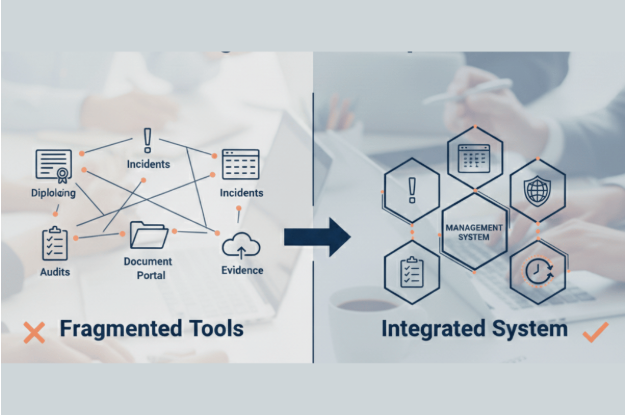
Another reason digital ISO systems fail is that organisations already have too many tools.
Platform for training.
Separate system for incidents.
Spreadsheet for risk.
Portal for document control.
Tool for audits.
Shared drive for evidence.
Each tool has its own workflow and terminology. Each tool produces its own version of reality. Over time, leaders become overwhelmed and teams stop trusting the data. People start maintaining records for compliance purposes, but they stop using the system as a decision-making tool.
This is how digital systems can actually increase risk. They create fragmentation. They create inconsistency. They increase the workload required to maintain coherence across quality, safety, and environmental controls.
When the organisation becomes overloaded with compliance tools, ISO stops being a management system and becomes an administrative burden. That is the opposite of what ISO standards were intended to achieve.
The Real Differentiator: Execution Versus Documentation
This is the core issue.
Management system standards are built around execution. They require evidence, but the evidence is meant to reflect how the organisation actually operates. When organisations treat ISO as paperwork, they create systems that sit beside operations rather than inside them.
Digital tools can strengthen execution, but only if they are implemented with that intent. Otherwise, the organisation ends up with digitised paperwork and the same execution problems.
The system may look cleaner. It may even pass audits more easily. But the organisation has not improved its ability to manage quality, safety, or environmental risk.
What Digital ISO Should Look Like When Done Properly
A properly designed digital ISO approach does not begin with uploading documents. It begins with understanding how work flows through the organisation and where control is needed.
It focuses on:
How risks are identified as work evolves
How decisions are made and documented at the right moment
How responsibility is assigned and stays visible
How actions are tracked to completion with verification
How management review is based on current, reliable data
How learning and improvement are built into normal operations
In this model, digital ISO systems act as support mechanisms. They reduce friction. They reduce manual coordination. They reduce reliance on memory. They preserve organisational knowledge beyond individual roles.
That is the real value of digitisation. Not that the system becomes “paperless,” but that it becomes more resilient.
A Simple Test: Is the System Supporting Decisions in Real Time?
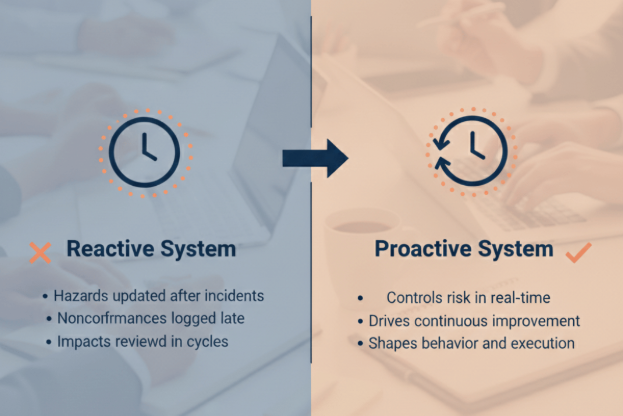
A useful way to assess any digital ISO implementation is to ask a basic question:
Does the system influence decisions before things go wrong?
Hazards are only updated after incidents, the system is not controlling risk.
Quality nonconformances are logged late, the system is not driving improvement.
Environmental impacts are reviewed only during reporting cycles, the system is not shaping behaviour.
This is why many organisations feel their system is technically complete but practically ineffective. The system exists, but it is not active. It does not travel with the work. It does not shape execution.
Final Thought: Digital ISO Is a Support Mechanism, Not a Solution
It is tempting to believe that software will fix what spreadsheets and folders could not. But software only amplifies what already exists. If the underlying management system is weak, the organisation will end up with a faster version of weak control.
Digital ISO systems are valuable when they strengthen execution. They support accountability. They improve visibility. They reduce reliance on individual memory and manual follow-ups. They help organisations manage complexity with more consistency.
But they are not a solution in themselves.
A strong ISO system is still defined by how work is planned, controlled, monitored, reviewed, and improved. The tool should support that operating model, not substitute for it.
Because ISO was never about having the right documents. It was always about how the organisation operates.