
Why ISO 9001, ISO 45001, and ISO 14001 Fail When They’re Treated as Paperwork
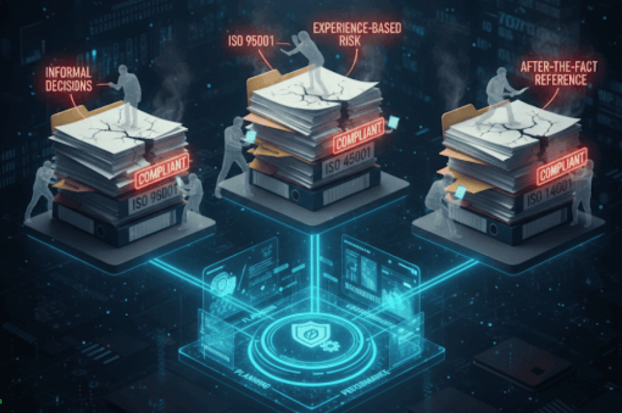
Most organisations that struggle with ISO standards are not struggling because they lack effort. In many cases, they are doing exactly what they believe is required. Documents are written. Registers are maintained. Audits are passed. Certificates are renewed.
On the surface, everything appears compliant.
Yet beneath that surface, something doesn’t quite hold. Decisions are still made informally. Risks are managed through experience rather than structure. Accountability depends on who is involved, not on what the system requires.
When problems arise, the ISO system rarely leads the response. It is referenced after the fact, not relied on in the moment.
This is where ISO standards quietly fail — not because the requirements are misunderstood, but because they are treated as paperwork rather than operating systems.
What often goes unrecognised is that these failures rarely occur within a single standard. They emerge at the intersections — where quality, safety, and environmental considerations should align but instead operate in isolation. This is why integrated management systems are increasingly critical for organisations operating in complex, high-risk environments. Without integration, even well-documented ISO systems struggle to support real-world decision-making.
ISO Standards Were Never Designed to Sit in Folders
ISO 9001, ISO 45001, and ISO 14001 are management system standards. That distinction matters more than many organisations realise.
An ISO 9001 management system is intended to stabilise quality outcomes as complexity increases.
An ISO 45001 safety management system is intended to actively control risk in environments where conditions change daily.
An ISO 14001 environmental management system is intended to ensure environmental impact is considered as part of operational decision-making, not after it.
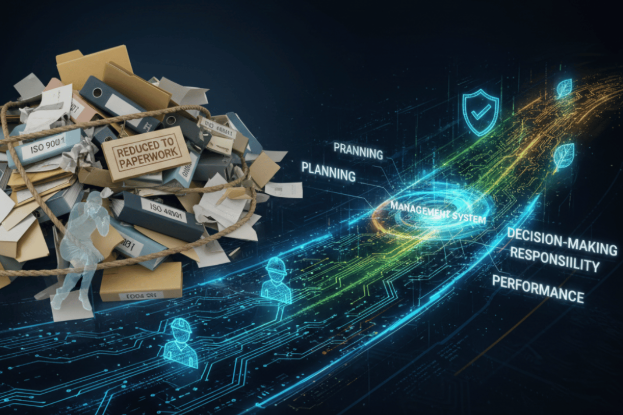
None of these standards were designed to exist primarily as documents. They were designed to shape how organisations plan work, make decisions, assign responsibility, and review performance.
When they are reduced to paperwork, their purpose is quietly reversed.
The Paperwork Trap
Paperwork-driven ISO systems tend to follow a familiar pattern.
Procedures are written once and rarely revisited. Risk registers are updated periodically, often in preparation for audits. Evidence is gathered retrospectively by a small group of people who “own compliance”.
The system appears orderly, but it operates alongside the business rather than within it.
Over time, teams adapt. They learn which documents matter for audits and which can be ignored. The ISO system becomes something to maintain rather than something to use.
This is not usually deliberate. It is structural.
Capability Cannot Rely on Memory
In many SMEs, real capability lives in people rather than in systems. There are supervisors who know how work actually gets done, managers who sense when something is about to go wrong, and individuals who carry years of experience that never quite makes it into formal processes.
For a time, this works. Things hold together because the right people are in the right places.
The problem is that memory does not scale.
As organisations grow, projects overlap, teams rotate, and pressure increases. Decisions are made faster and often with incomplete information. When capability exists mainly in people’s heads, consistency becomes fragile. Outcomes begin to depend on who happens to be present rather than on how work is designed to operate.
This is where management systems quietly lose their power. When quality, safety, or environmental control relies on experience alone, gaps appear as soon as conditions change. Controls are applied unevenly. Risks are recognised too late. Lessons are relearned rather than embedded.
True organisational capability shows up when performance is repeatable under stress, change, and turnover. That only happens when systems carry responsibility forward, making expectations, decisions, and controls visible regardless of who is involved.
When memory does the heavy lifting, systems become optional. When systems do the heavy lifting, organisations become resilient.
Where Documentation Falls Short in Daily Operations
On paper, many ISO systems look complete. In practice, their limitations are evident in day-to-day work.
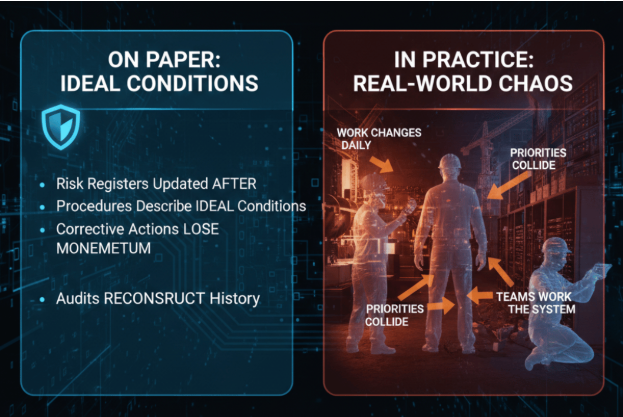
Risk registers are updated after tasks are completed, not as work evolves. Procedures describe ideal conditions, not real ones. Corrective actions are recorded but quietly lose momentum as scrutiny wanes.
Internal audits often uncover issues that have existed for months. External audits become moments of reconstruction rather than validation.
None of this usually reflects poor intent. It reflects systems that sit outside the flow of work.
Construction sites, manufacturing floors, engineering projects, and professional services environments rarely operate under stable conditions. Work changes daily. Priorities collide. Documentation-heavy systems struggle here because they require deliberate effort to remain relevant.
Over time, teams work around the system instead of through it.
The Illusion of Control
One of the most damaging outcomes of paperwork-based ISO systems is the illusion of control they create.
Registers exist, so leaders assume risks are managed. Procedures are approved, so consistency is expected. Audits have passed; performance is therefore assumed acceptable.
In reality, these documents often reflect how the organisation intended to operate at some point in the past, rather than how it operates today.
When audits expose this gap, the response is usually more documentation. More templates. More registers. Each layer increases complexity while reducing usability.
The system grows heavier, but not stronger.
When Documentation Becomes a Substitute for Control
One of the quieter failures of paperwork-driven ISO systems is that documentation begins to stand in for control itself. When something is written down, approved, and stored, it is often assumed to be managed.
In reality, documentation only represents intent. Control exists in execution.
This distinction matters because management systems are meant to operate continuously, not episodically. An ISO 9001 management system should influence quality decisions under pressure. An ISO 45001 safety management system should shape behaviour before work begins, not only after incidents occur. An ISO 14001 environmental management system should guide trade-offs when environmental impact competes with time, cost, or convenience.
When documentation becomes the system’s primary output, attention shifts away from whether controls are effective in practice. Reviews become retrospective. Audits become moments of rediscovery.
Over time, confidence in the system erodes. Teams comply because they must, not because the system helps them perform.
The Role of Digitally Integrated Management Systems
This is where digitally integrated management systems truly become essential.
A digitally integrated management system is not three standards combined into a single manual, and it is not simply a cleaner way to store documents. It is a digital operating system that supports how work actually happens, embedding quality, safety, and environmental considerations directly into how activities are planned, executed, tracked, and reviewed.
When an ISO 9001 management system, ISO 45001 safety management system, and ISO 14001 environmental management system operate as separate, document-driven structures, fragmentation becomes difficult to avoid. Risks are assessed in isolation. Actions are tracked across disconnected tools or spreadsheets. Knowledge sits with individuals rather than being retained by the organisation. Over time, continuity depends more on experience than on system design.
Digitally integrated systems address this by creating shared workflows, shared data, and shared accountability across quality, safety, and environmental domains. Decisions are assessed once, in context, rather than being interpreted repeatedly across different registers or reports.
Supported by automation and real-time visibility, these systems preserve organisational knowledge beyond individual roles. Reviews focus on how the system performed in practice, not simply whether documentation exists. In environments where people, projects, and conditions constantly change, this shift from document control to system-driven execution becomes critical.
Moving Beyond Paperwork
ISO 9001, ISO 45001, and ISO 14001 do not fail because they are demanding. They fail when implemented as static artefacts rather than as living systems. The future of ISO implementation is not heavier documentation or stricter templates. It is better system design. ISO standards already provide the framework. The challenge lies in operationalising them in a way that reflects reality.
This is where integrated management systems really start to matter. Not because they make compliance easier, but because they change how decisions are made in real situations.
When quality, safety, and environmental considerations sit inside the same system, people stop thinking in silos. Trade-offs become visible earlier. Risks are considered once, in context, instead of being checked later in separate registers.
Over time, this changes behaviour. Accountability feels clearer. Decisions feel more deliberate. The system supports the work instead of chasing it. That’s when ISO stops feeling like an obligation and starts functioning the way it was always meant to.
When ISO systems are treated as systems of accountability rather than collections of documents, they cease to be burdens and become assets. The change did not come from better paperwork. It came from a stronger organisation.