
Open the corrective action register in most certified businesses and you will find the same pattern. A long list of nonconformities, a column of actions that say "retrained staff" or "reminded the team", and a growing number of items marked open, overdue or closed with no evidence behind them. Six months later, the same problems are back on the list with new dates.
That is not a paperwork problem. It is a sign that the business is fixing symptoms instead of causes. Clause 10.2 of ISO 9001, ISO 45001 and ISO 14001 exists to stop that cycle. It asks you to understand why something went wrong, remove the cause, and prove the fix worked. Done properly, corrective action is the engine of improvement in your management system. Done badly, it is a list that never gets shorter.
Here is what the standards actually ask for, why most registers fill up and never empty, and how to run corrective actions that genuinely close.
Correction Is Not Corrective Action
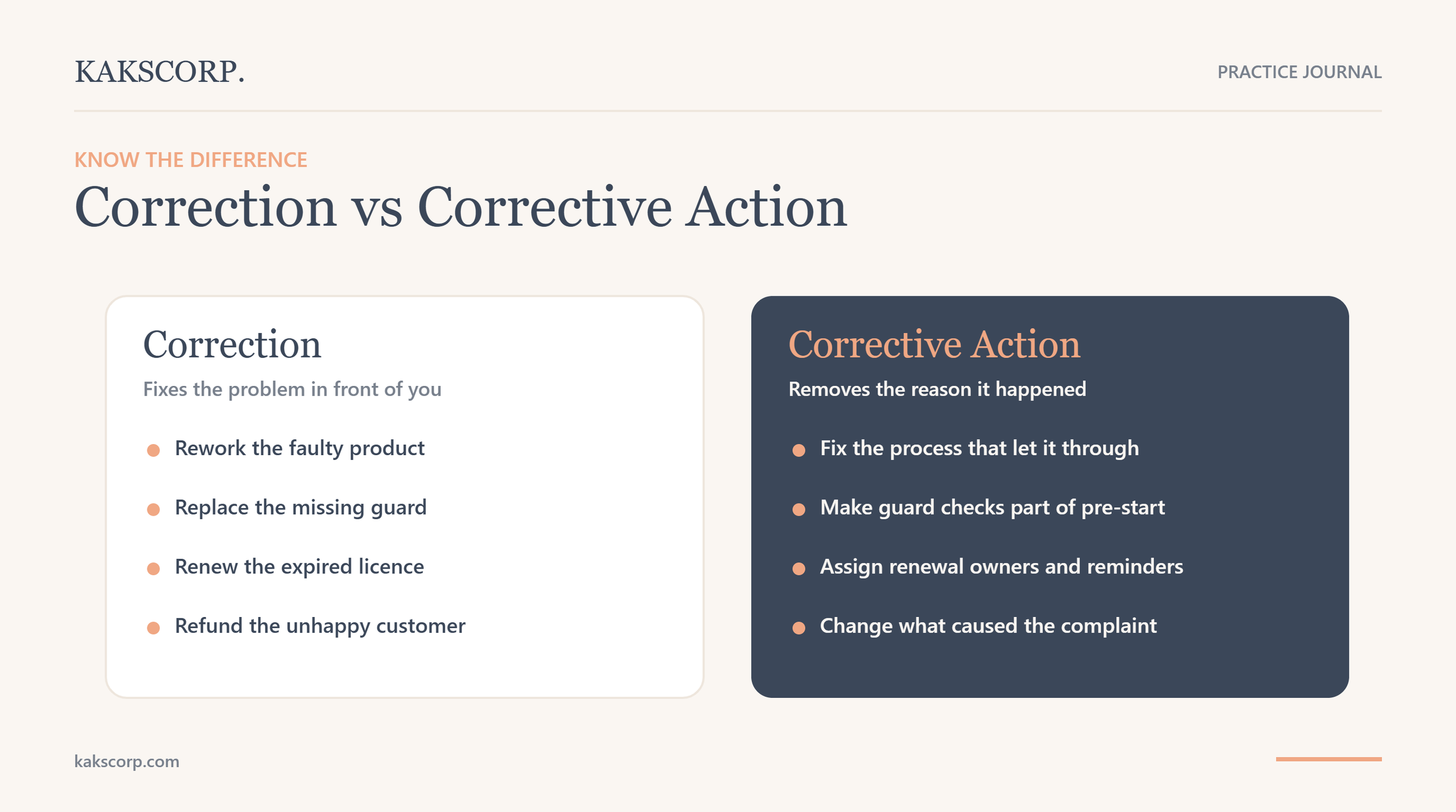
The most common mistake is treating a correction as if it were a corrective action. A correction deals with the problem in front of you. You rework the faulty product, replace the missing guard, update the expired licence or refund the unhappy customer. It is necessary, and it should happen quickly.
A corrective action deals with why the problem happened in the first place, so it does not happen again. If a licence expired because nobody owns the renewal dates, renewing the licence is the correction. Assigning ownership and putting renewals into a register with automatic reminders is the corrective action.
When a register is full of corrections labelled as corrective actions, the business is paying to fix the same problems over and over.
What Clause 10.2 Actually Asks For
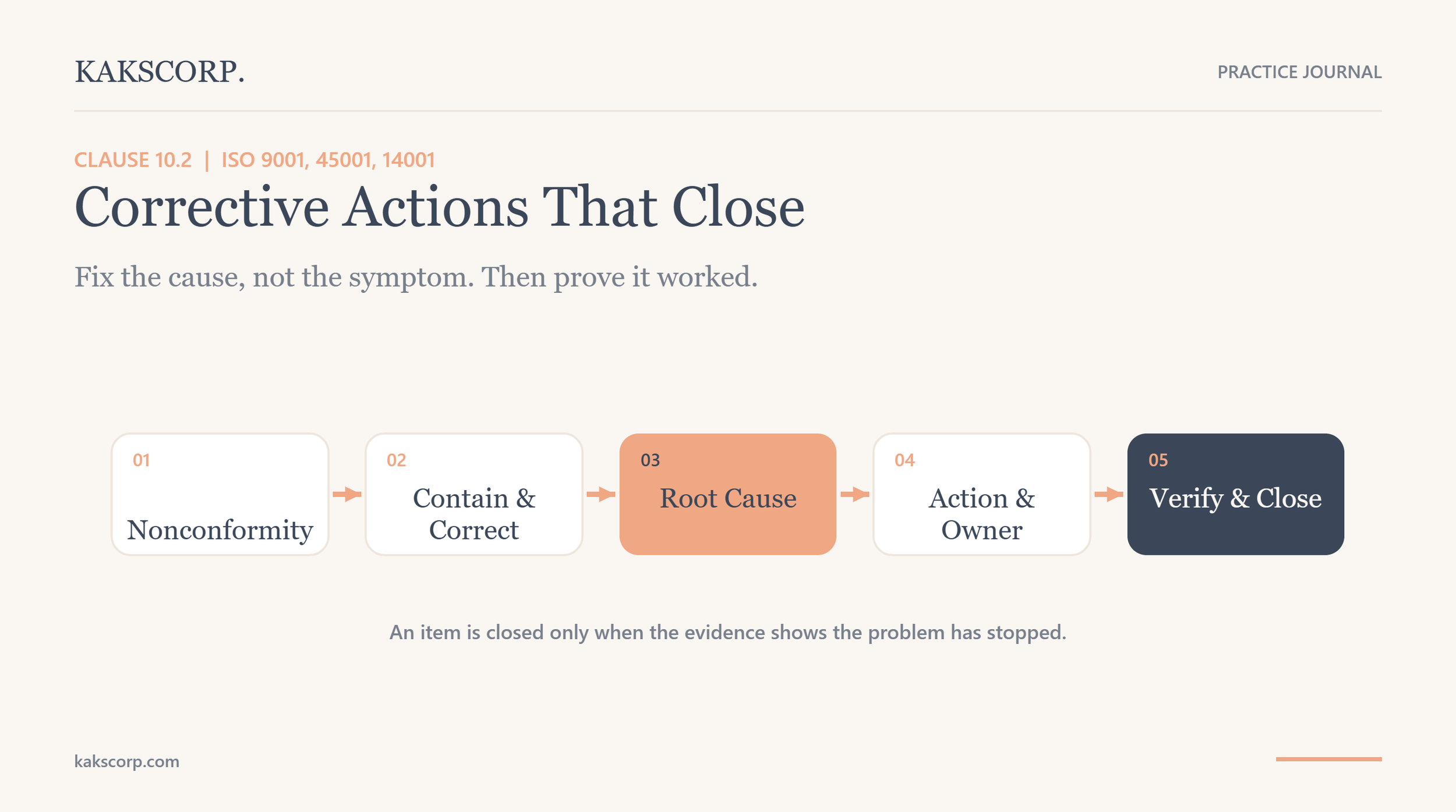
The requirement is more structured than most businesses realise. When a nonconformity occurs, you must react to it by controlling and correcting it and dealing with the consequences. You must then evaluate whether action is needed to eliminate the cause, by reviewing the nonconformity, determining its causes, and checking whether similar nonconformities exist or could occur elsewhere.
From there, you implement the action needed, review the effectiveness of what you did, update your risks and opportunities if necessary, and make changes to the management system where required. You also retain evidence of the nature of the nonconformity, the actions taken and the results. ISO 45001 adds that workers should be involved, and that incidents are investigated with the same rigour.
Read in full, the clause describes a loop, not a form. It starts with a problem and only ends when you have evidence the problem has stopped happening.
Why Corrective Action Registers Never Empty
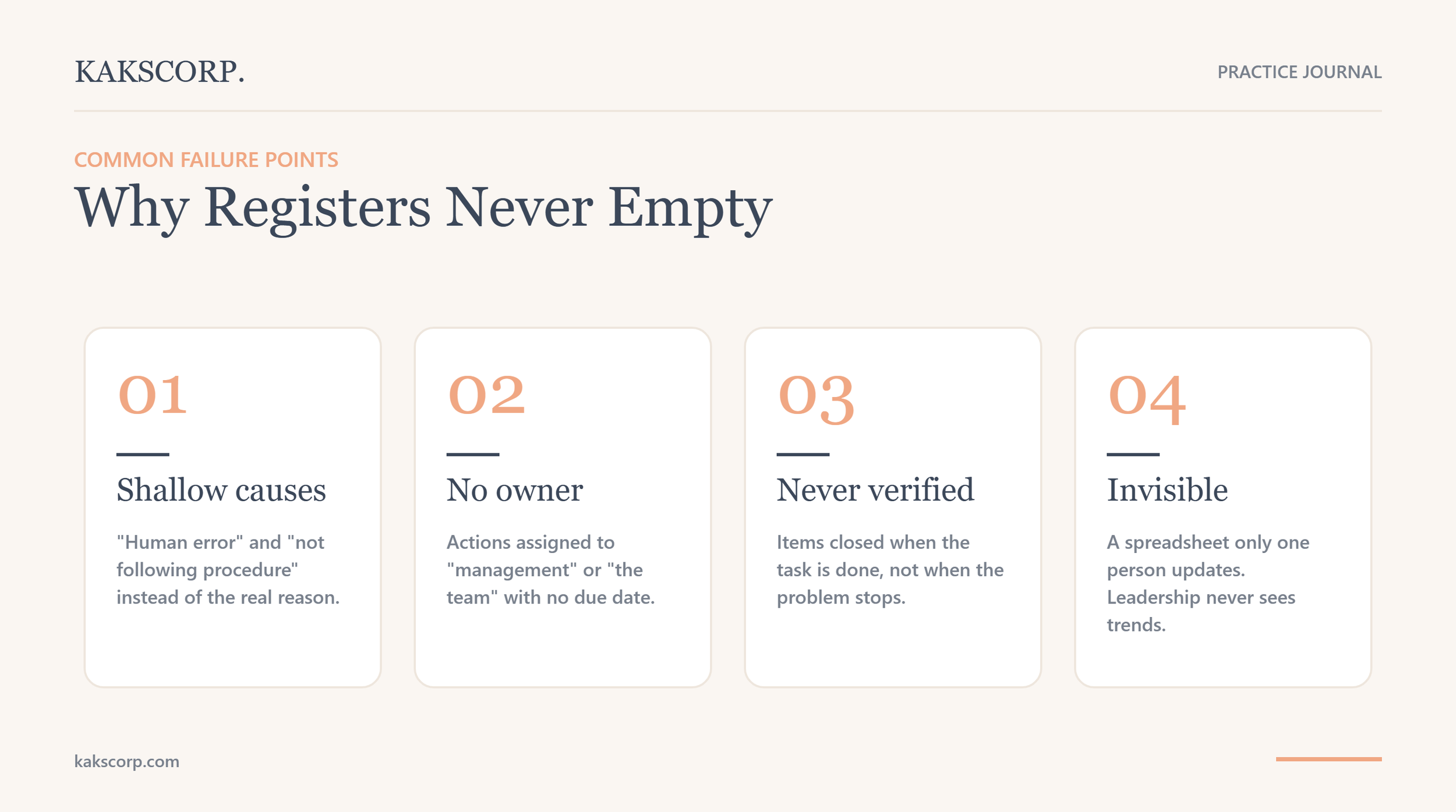
The first reason is shallow investigation. "Human error" and "staff not following procedure" appear as root causes in almost every register we review. They are rarely the real cause. People make errors when the process makes errors easy: unclear instructions, too many manual steps, no checks at the point where mistakes happen, or competing priorities that push the procedure aside.
The second reason is ownership. Actions are raised in an audit or a meeting, assigned to "management" or "the team", and given no due date. Without a named owner and a deadline, nothing moves until the next audit finds the same issue. The third reason is that nobody checks whether the fix worked. Items get closed the moment an action is completed, not when the evidence shows the problem has gone away.
Finally, many registers live in a spreadsheet that only one person updates. Leadership never sees the trend, so repeat issues and ageing actions stay invisible until they become an audit finding. A register nobody looks at is a register nobody acts on.
Finding the Real Root Cause
Good root cause analysis does not need to be complicated, but it does need to be honest. The simplest tool is asking why, repeatedly, until you reach something the business can actually change. A delivery went out with the wrong parts. Why? The picker took the wrong item. Why? Two similar parts share the same shelf location. Why? Nobody reviewed the layout when the new product line was added. Now you have a cause worth fixing.
For more complex problems, look across the categories that usually contribute: people, methods, equipment, materials, environment and measurement. Involve the people who do the work. They almost always know where the process breaks down, and they are more likely to support a fix they helped design.
Then ask the question most businesses skip: where else could this happen? If one site, crew or product line has the problem, others with the same process probably do too. Clause 10.2 expects you to look, and it is far cheaper to fix a cause once than to discover it three more times.
Closing the Loop: Verifying Effectiveness
An action is not finished when it is done. It is finished when you have evidence it worked. Before closing an item, decide what proof will show the fix was effective: a follow-up audit of the process, a month of clean inspection results, no repeat incidents over a set period, or a measurable improvement in the relevant objective.
Build that check into the action itself, with its own date. Then close the item only when the evidence is in. Verified closure is what separates a corrective action process from a to-do list.
What a Healthy Register Looks Like
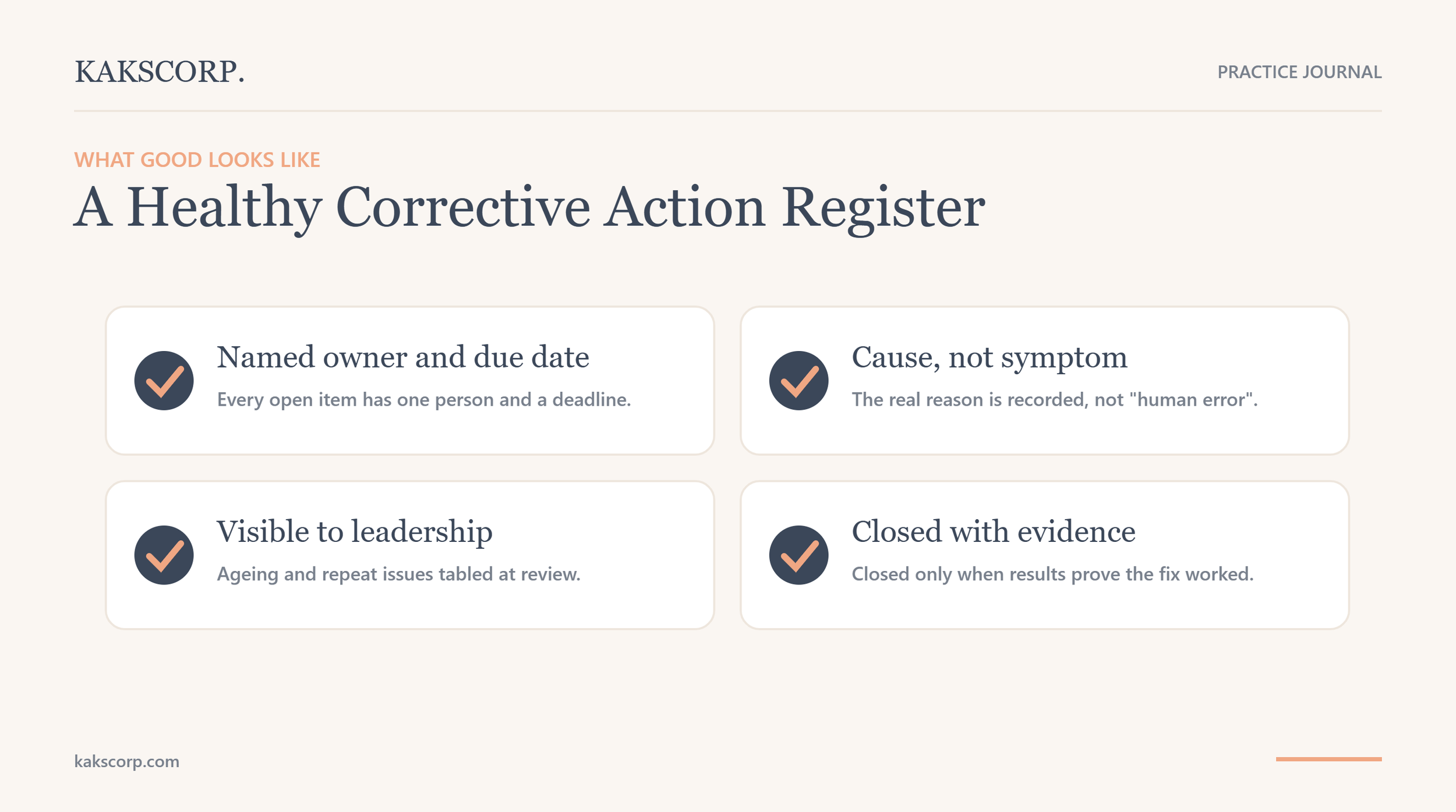
In a business that runs corrective action well, the register is short, current and useful. Every open item has a named owner, a due date and a clear description of the cause, not just the symptom. Ageing actions are visible to leadership, and overdue items are discussed at the management review rather than discovered by the auditor.
Repeat issues drop over time because causes are being removed. Trends are easy to spot because the data lives in one connected system rather than scattered across spreadsheets and inboxes. Auditors see a living process with evidence of improvement, which is exactly what certification bodies want to find.
Most importantly, the team stops seeing nonconformities as blame. They become information about where the system needs to get better. That shift, from fixing problems to removing their causes, is where a management system starts paying for itself.
