
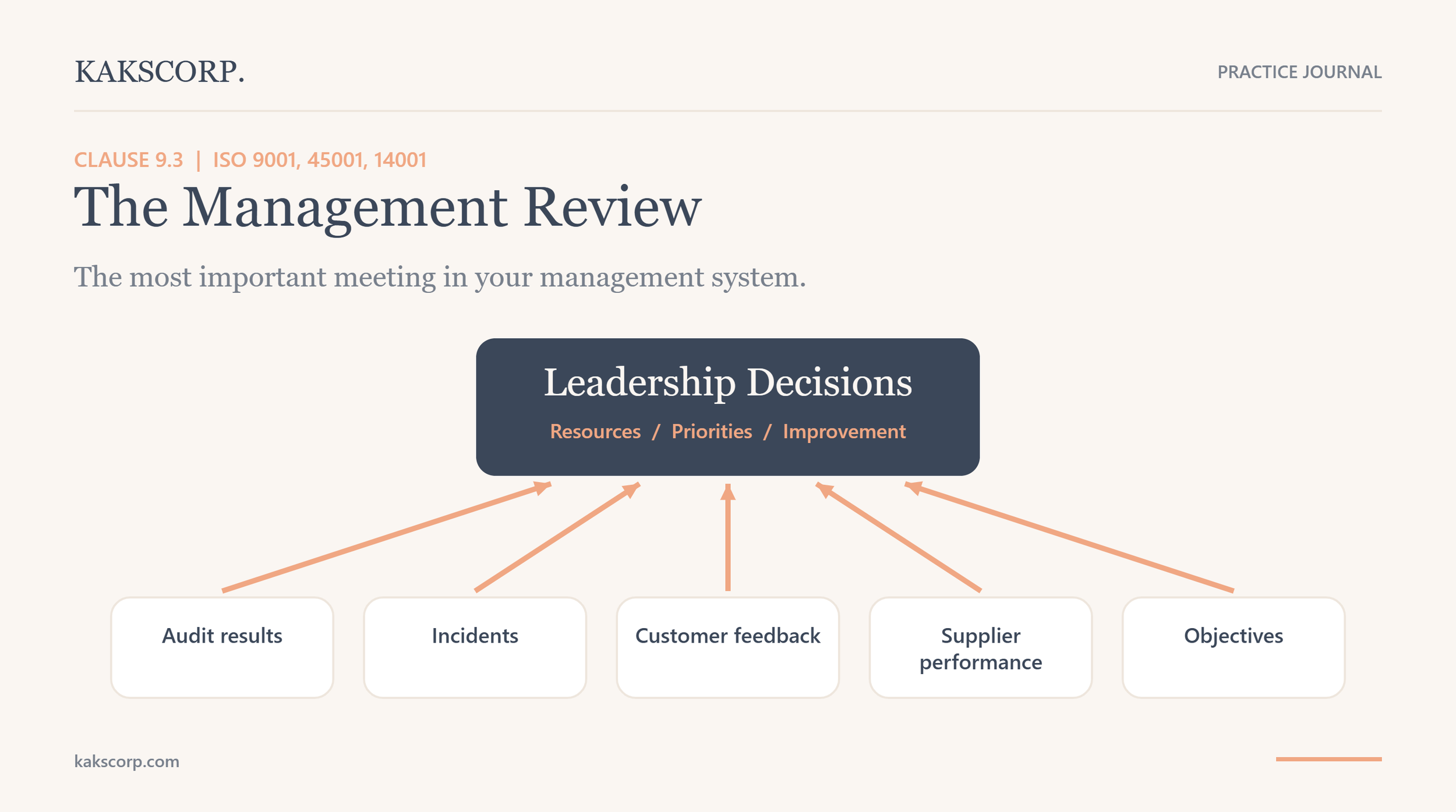
Every certified business holds a management review. Most hold it once a year, usually a few weeks before the surveillance audit, and usually because the auditor will ask to see the minutes. The agenda gets copied from last year, the inputs are pulled together the night before, and the meeting closes with a list of actions that looks remarkably like the previous year's list.
That is a waste of the single most powerful requirement in ISO 9001, ISO 45001 and ISO 14001. Clause 9.3 is the one place where the standards ask leadership to sit down, look at the evidence the system has produced, and decide what happens next. Done properly, it is a strategy session with data behind it. Done as a formality, it teaches everyone in the business that the system is something you perform for an auditor.
As the year closes out and planning for the next one begins, this is the right moment to rethink how your management review works. Here is what it is actually for, where it usually goes wrong, and how to run one that changes decisions.
What the Management Review Is Actually For
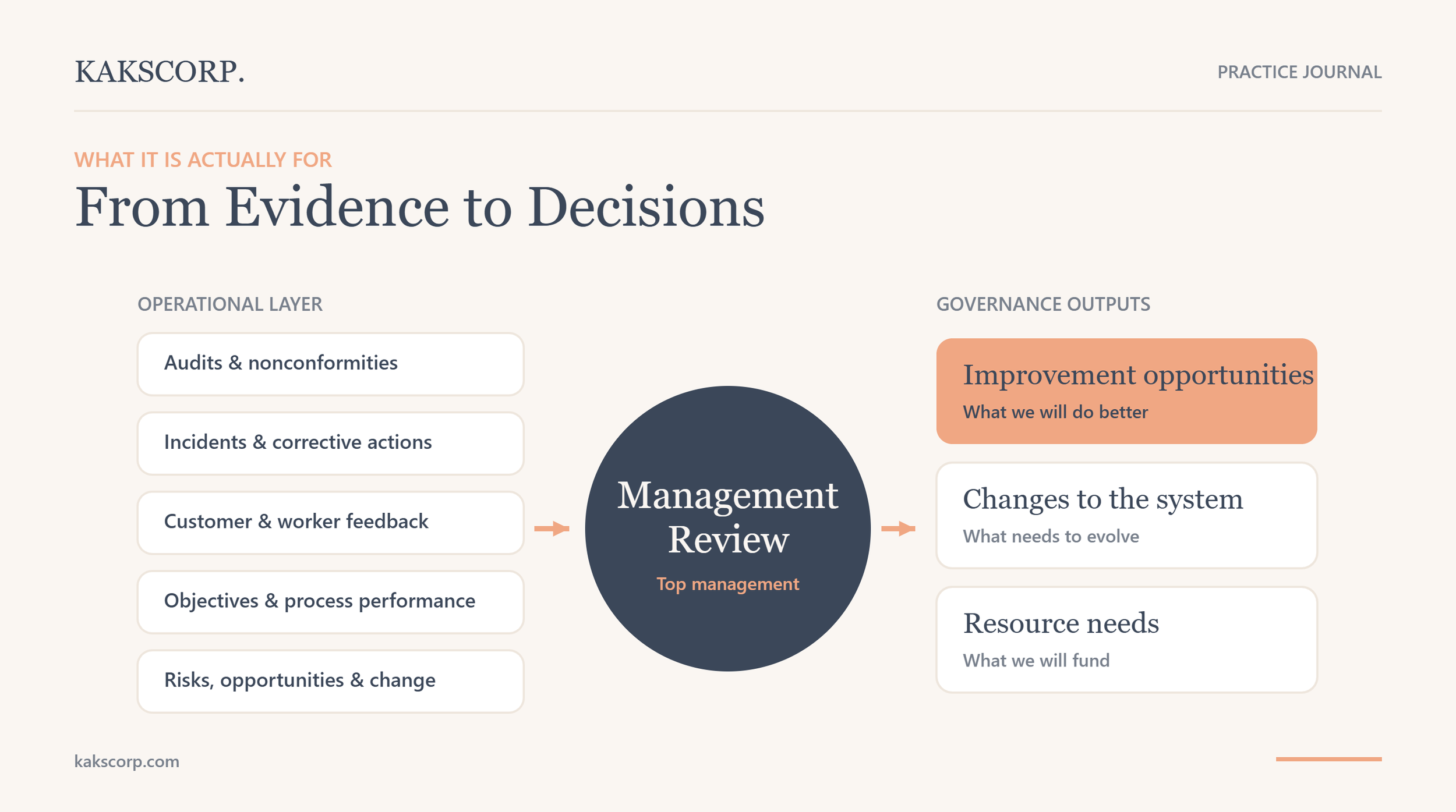
The standards are clear about intent. Top management must review the management system at planned intervals to ensure its continuing suitability, adequacy and effectiveness, and its alignment with the strategic direction of the organisation. That last phrase matters. The review is not a check that documents exist. It is a check that the system is still pointing the business where leadership wants it to go.
Think of it as the point where the operational layer reports up to the governance layer. Throughout the year, your system generates evidence: audit results, nonconformances, incidents, customer feedback, supplier performance, progress against objectives and changes in risk. The management review is where that evidence is turned into leadership decisions about resources, priorities and improvement.
If nothing in the business would be different after the meeting, the review has not done its job, regardless of how complete the minutes look.
The Inputs Are a Health Check, Not a Checklist
Clause 9.3.2 sets out what the review must consider. It includes the status of actions from previous reviews, changes in external and internal issues, customer satisfaction and feedback, the extent to which objectives have been met, process performance, nonconformities and corrective actions, monitoring and measurement results, audit results, the performance of external providers, the adequacy of resources, the effectiveness of actions taken to address risks and opportunities, and opportunities for improvement. ISO 45001 adds worker consultation and participation and incident performance. ISO 14001 adds compliance obligations and environmental performance.
Most businesses treat this list as a template with headings to fill in. The better approach is to treat each input as a question. Are we hitting our quality objectives, and if not, why not? Which suppliers keep causing rework? What did the last three incidents have in common? Has anything changed in our market, our contracts or our regulatory environment that the system has not caught up with?
When the inputs are framed as questions, the conversation shifts from reporting to diagnosis. That is when leadership starts to see patterns, and patterns are where the real value sits. A single late delivery is an event. Six late deliveries from the same supplier over two quarters is a decision waiting to be made.
Where Management Reviews Go Wrong
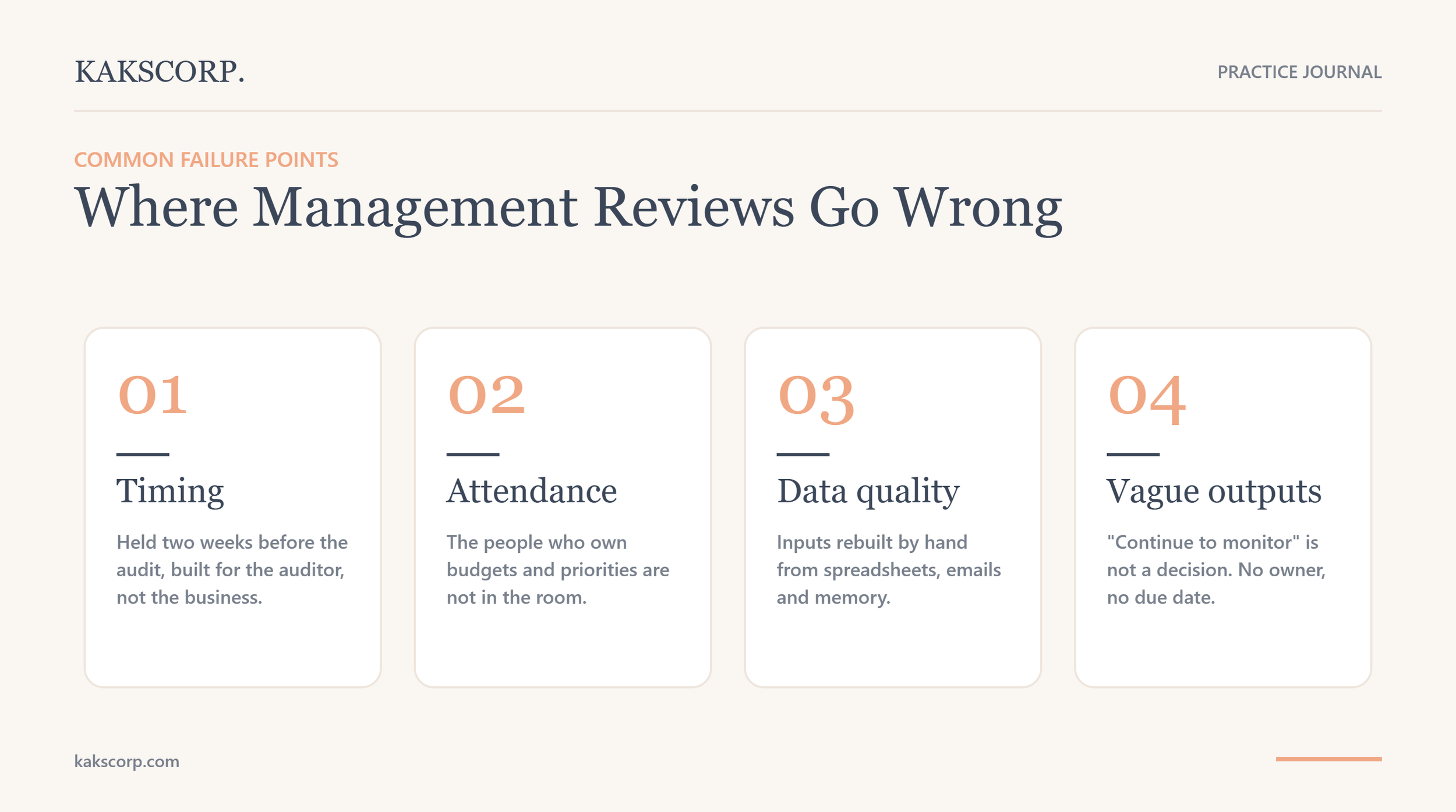
The most common failure is timing. A review held two weeks before the audit is designed to satisfy the auditor, not to inform the business. The second is attendance. If the people who own budgets and priorities are not in the room, the review can identify problems but cannot resolve them, and the actions drift from one year to the next.
The third failure is data quality. When inputs are assembled by hand from spreadsheets, email threads and memory, the review depends entirely on whoever prepared the pack. Gaps get smoothed over. Trends stay invisible because nobody has the history in one place. This is one of the clearest arguments for a digital management system. When registers, audits, incidents and objectives live in one connected platform, the review pack is largely built before anyone asks for it, and the evidence is current rather than reconstructed.
The final failure is outputs that are not really outputs. Clause 9.3.3 requires decisions on opportunities for improvement, any need for changes to the management system, and resource needs. "Continue to monitor" is not a decision. Every output should have an owner, a due date and a clear reason it matters.
How to Run a Management Review That Changes Decisions
Start by putting the review on the leadership calendar as a fixed event, aligned to your business planning cycle rather than your audit date. For many Australian businesses, a review in late November or early December feeds directly into budgets and priorities for the new year, which is exactly where its conclusions should land.
Circulate the input pack at least a week before the meeting, with a one-page summary on top: what improved, what got worse, and what needs a decision. Leaders should arrive having read it, so the meeting is spent on discussion rather than presentation.
Run the meeting around decisions. For each input area, ask two questions: what is the evidence telling us, and what are we going to do about it? Record the decisions, the owners and the resources committed. Then track those actions through the year, so the next review opens with an honest look at what was actually delivered.
Pair It With a Proper Internal Audit
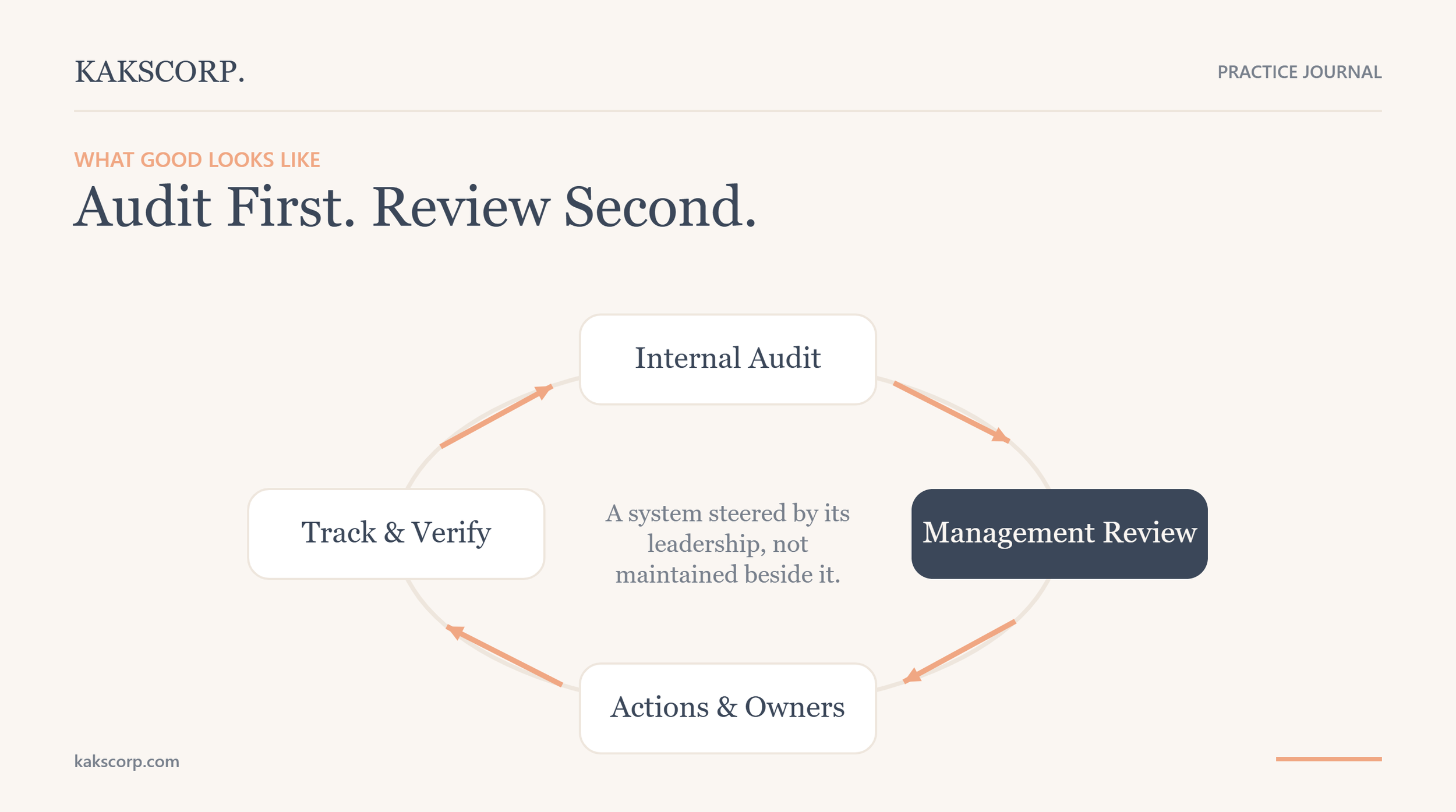
The internal audit tells you whether the system is working as designed. The management review decides what to do about what the audit found. Run them in sequence, audit first and review second, and each makes the other far more useful.
An internal audit without a review produces findings nobody acts on. A review without a recent audit produces decisions built on assumptions.
What Good Looks Like
In a business that runs its review well, the meeting feels less like compliance and more like a board session. Quality, safety and environmental data sits alongside commercial performance. Leaders debate real trade-offs: whether to invest in training to reduce rework, whether a supplier relationship is still worth keeping, whether a new contract requirement means the system needs to extend to another standard.
The minutes are short, specific and actionable. Twelve months later, the business can point to changes that came directly out of the review, and the auditor sees a system that is genuinely being steered by its leadership rather than maintained beside it.
That is the difference between a management system that exists for the certificate and one that exists for the business. The management review is where that difference becomes visible, and it is the easiest place to start closing the gap before the new year begins.
