
What are the mandatory documented requirements for ISO 9001, ISO 14001 and ISO 45001 certification in Australia?
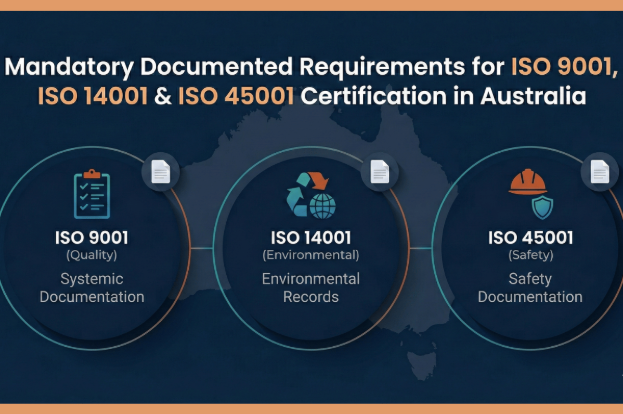
For organisations seeking ISO 9001, ISO 14001 or ISO 45001 certification in Australia, the mandatory documented requirements are defined within each standard.
Certification bodies accredited by JAS-ANZ assess whether required documented information:
Has been established
Is controlled through a documented control process
Is current and approved
Is retained where required
Demonstrates conformity to the relevant ISO standard
Demonstrates compliance with applicable Australian legislation
Each standard requires two categories of documented information:
Documented information to be maintained
Documented information to be retained as evidence
“Maintained” means the information must be kept current and controlled.
“Retained” means records must be kept as objective evidence of conformity.
The following outlines the mandatory documented requirements under each standard.
ISO 9001:2015 – Mandatory Documented Requirements
ISO 9001:2015 specifies documented information required to demonstrate effective operation of a Quality Management System.
Documented Information to Be Maintained
1. Scope of the Quality Management System (Clause 4.3)
The organisation must maintain documented information defining:
The products and services covered by the QMS
The physical and organisational boundaries of the system
Any exclusions, with justification
The scope must reflect actual operations and certification boundaries.
2. Quality Policy (Clause 5.2)
A documented quality policy must:
Be appropriate to the organisation’s purpose
Include commitment to meeting customer and regulatory requirements
Include commitment to continual improvement
Be communicated and available
3. Quality Objectives (Clause 6.2)
The organisation must maintain documented quality objectives including:
Measurable targets
Assigned responsibilities
Required resources
Timeframes
Evaluation methods
4. Operational Planning and Control (Clause 8.1)
Documented information must be maintained to support operational processes where necessary to ensure:
Consistent delivery of products and services
Control of outsourced processes
Defined acceptance criteria
The extent of documentation depends on organisational complexity.
Documented Information to Be Retained as Evidence
5. Evidence of Competence (Clause 7.2)
Records must demonstrate that personnel are competent based on:
Education
Training
Skills
Experience
6. Monitoring and Measuring Resources (Clause 7.1.5)
Records must demonstrate:
Calibration or verification of equipment
Traceability to measurement standards where applicable
7. Review of Customer Requirements (Clause 8.2.3)
Records must demonstrate review and acceptance of customer requirements before commitment.
8. Design and Development Records (Clause 8.3 – if applicable)
Where design applies, records must include:
Design inputs
Design outputs
Design reviews
Verification
Validation
Design changes
9. Control of Externally Provided Processes (Clause 8.4)
Records must demonstrate:
Supplier evaluation
Selection criteria
Monitoring and re-evaluation
10. Identification and Traceability (Clause 8.5.2 – where required)
Where traceability is required, documented records must be retained.
11. Nonconforming Outputs (Clause 8.7)
Records must demonstrate:
Description of nonconformity
Actions taken
Concessions obtained
12. Monitoring and Measurement Results (Clause 9.1)
Records demonstrating conformity of products and services.
13. Internal Audit Programme and Results (Clause 9.2)
Documented:
Audit programme
Audit criteria
Audit scope
Audit findings
14. Management Review Outputs (Clause 9.3)
Records of:
Decisions
Actions
Resource allocation
Improvement opportunities
15. Nonconformity and Corrective Action (Clause 10.2)
Records must include:
Nature of nonconformity
Corrective action taken
Results of action
Evidence of effectiveness
ISO 14001:2015 – Mandatory Documented Requirements
ISO 14001 requires documented information demonstrating environmental management and legal compliance.
Documented Information to Be Maintained
1. Scope of the Environmental Management System (Clause 4.3)
Defined environmental boundaries of the EMS.
2. Environmental Policy (Clause 5.2)
Documented policy including commitments to:
Environmental protection
Compliance with obligations
Continual improvement
3. Environmental Aspects and Impact Evaluation (Clause 6.1.2)
Documented methodology and records identifying:
Environmental aspects
Associated impacts
Significance criteria
4. Compliance Obligations Register (Clause 6.1.3)
Documented register identifying:
Applicable federal environmental legislation
State or territory EPA regulations
Other binding environmental obligations
5. Environmental Objectives and Planning (Clause 6.2)
Documented environmental objectives and action plans.
6. Operational Controls (Clause 8.1)
Documented controls required to manage significant environmental aspects.
7. Emergency Preparedness and Response (Clause 8.2)
Documented emergency response procedures.
Documented Information to Be Retained
8. Monitoring and Measurement Results (Clause 9.1)
Environmental monitoring records.
9. Evaluation of Compliance (Clause 9.1.2)
Records demonstrating evaluation of compliance with legal obligations.
10. Internal Audit Programme and Results (Clause 9.2)
Documented audit planning and retained findings.
11. Management Review Outputs (Clause 9.3)
Records of management review decisions and actions.
12. Nonconformity and Corrective Action (Clause 10.2)
Records demonstrating:
Environmental nonconformities
Corrective actions
Effectiveness verification
ISO 45001:2018 – Mandatory Documented Requirements
ISO 45001 requires documented information demonstrating occupational health and safety risk control.
In Australia, this must align with Work Health and Safety legislation applicable in the relevant jurisdiction.
1. Scope of the OH&S Management System (Clause 4.3)
The organisation must document the scope of its OH&S management system.
This must clearly define:
Physical and organisational boundaries
Activities, products and services covered
Relevant internal and external issues
Any justified exclusions
The scope must reflect actual operations in Australia, including site locations and contracted activities where applicable.
2. OH&S Policy (Clause 5.2)
A formally documented OH&S policy is mandatory.
It must include commitments to:
Providing safe and healthy working conditions
Eliminating hazards
Reducing OH&S risks
Fulfilling legal and other requirements
Continual improvement of the OH&S management system
Worker consultation and participation
The policy must be approved by top management and communicated internally.
3. Hazard Identification and Risk Assessment Methodology (Clause 6.1.2)
ISO 45001 requires documented methodology for managing risks.
This must define:
How hazards are identified
How risks are assessed
Criteria for determining significance
How risk controls are selected and implemented
While the standard does not mandate a specific format, most organisations maintain a hazard register or risk register that is formally controlled.
4. Legal and Other Requirements Register (Clause 6.1.3)
The organisation must document how it identifies and accesses applicable legal requirements.
This register must identify:
Relevant WHS legislation (state or federal)
Applicable codes of practice
Industry-specific regulatory obligations
Any contractual safety obligations
For Australian certification, auditors will expect clear linkage between identified legal requirements and operational controls.
5. OH&S Objectives and Planning (Clause 6.2)
Documented OH&S objectives must be established and maintained.
The documentation must include:
The objective itself
Measurable targets (where practicable)
Assigned responsibility
Timeframes
Evaluation method
Objectives must be consistent with the OH&S policy.
6. Operational Controls (Clause 8.1)
The organisation must document operational controls necessary to manage OH&S risks.
This may include:
Safe Work Method Statements (SWMS)
High-risk activity procedures
Contractor control processes
Maintenance controls
Procurement safety controls
The level of documentation must reflect the level of risk.
7. Emergency Preparedness and Response (Clause 8.2)
Documented emergency procedures are mandatory.
These must address:
Potential emergency scenarios
Roles and responsibilities
Communication protocols
Emergency response actions
Testing and review of emergency arrangements
In Australia, this typically includes fire response, medical emergencies, chemical spills, and site evacuation procedures.
Documented Information to Be Retained
Retained documented information provides objective evidence that the OH&S system is functioning.
8. Monitoring and Measurement Results (Clause 9.1)
The organisation must retain records demonstrating:
Safety performance monitoring
Inspection results
Incident frequency data
Health surveillance results (where applicable)
Monitoring must align with identified risks and objectives.
9. Evaluation of Compliance (Clause 9.1.2)
The organisation must retain records demonstrating periodic evaluation of legal compliance.
This includes evidence that:
WHS legal requirements are reviewed
Compliance is assessed
Gaps are identified
Corrective action is taken if needed
Auditors in Australia pay close attention to this area.
10. Incident Investigation Records (Clause 10.2)
The organisation must retain records relating to incidents and nonconformities.
These must include:
Description of the incident
Immediate actions taken
Root cause analysis
Corrective actions implemented
Verification of effectiveness
These records demonstrate system responsiveness and continual improvement.
11. Internal Audit Programme and Results (Clause 9.2)
The organisation must maintain a documented audit programme and retain:
Audit scope
Audit criteria
Audit reports
Identified nonconformities
Follow-up actions
The audit programme must consider the importance of processes and results of previous audits.
12. Management Review Outputs (Clause 9.3)
Records must be retained demonstrating that top management reviews the OH&S system.
These records must include decisions relating to:
Improvement opportunities
Resource needs
Changes to policy or objectives
Risk management effectiveness
Management review is a mandatory certification requirement.
Australian Certification Requirements
For ISO certification in Australia:
Certification bodies must be accredited by JAS-ANZ
Documented information must be controlled
Records must be retained for defined periods
Legal registers must reference applicable Australian federal and state legislation
Auditors verify both documentation and implementation
The mandatory documented requirements are those defined in ISO 9001:2015, ISO 14001:2015 and ISO 45001:2018.
No additional Australian-specific documentation is mandated beyond demonstrating compliance with applicable Australian laws.